
What accessories are used for seating?
Author: Sharon Jang | Reviewer: Emma M. Smith | Published: 25 May 2020 | Updated: ~
There are a variety of seating accessories that can be used to optimize comfort and posture. Although accessories can be used to enhance your seating, the majority of your posture should be supported through your seating set up (i.e., the backrest, cushion, foot rest), and not through accessories.
Upper extremity accessories
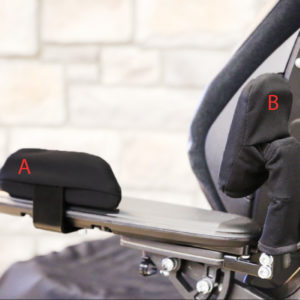
Arm supports to prevent the arm from falling off the side (A) and the elbow from sliding back (B).18
Seating accessories for the arms are more often found on power wheelchairs than manual wheelchairs. This group of accessories include armrest side supports and elbow blocks. Armrest side supports help prevent the forearm from falling off the side of the wheelchair, while elbow blocks prevent your elbows from sliding backwards. The use of these accessories can help keep your arm in place, especially when driving over rough terrain, and can help with repositioning.
Lower extremity support accessories
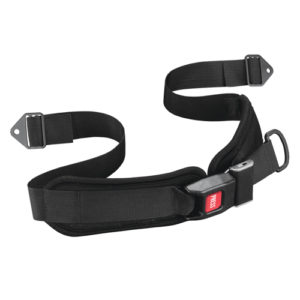
A two-point seatbelt (left) and a four-point seatbelt (right).19-20
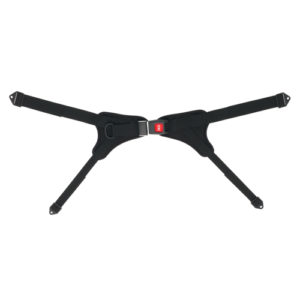
Various accessories are available to help support and position all parts of the lower limb including: the hips and buttock, knees, lower legs, and feet. To support the hips and the buttock, positioning belts (sometimes referred to as seat belts) can be used. When used on wheelchairs, positioning belts can help prevent the hips from sliding forward and help to keep the hips properly aligned (i.e., not tilted or rotated). Different types of positioning belts are available depending on your needs: two-point belts or four-point belts. Four-point belts offer more support to the hips if required. It is also important to note that safety belts are not the same as positioning belts. Although both may contribute towards safety, positioning belts are more specialized to help maintain your hip posture.
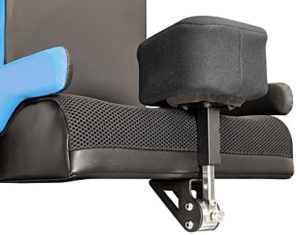
A pommel connected to the wheelchair.21
There are also an assortment of accessories to address knees that press inward, splay outward, or are windswept. To address knees that press inward, pommels are cushions mounted either to the wheelchair or cushion, which go between the knees to keep them separated; however, pommels that are too big may interfere with transferring. To address knees that splay outward, adductor pads can be used. These pads are placed on the outer edges of the wheelchair cushion, which support the thigh and prevent the knees from falling outward.
Some accessories for the feet and lower leg include strapping and pads. Heel and toe straps can be connected to the footplate to help prevent the foot from moving forward or backward. After SCI, this can be particularly useful to help manage tone in the lower legs, and ensure the person remains stable in their wheelchair. To support the calves, pads can be attached to the footrest. Calf pads are particularly used with power wheelchairs, as they can provide support to the calves during tilting or reclining.
Trunk Support
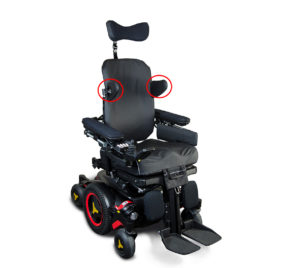
Lateral supports on a power wheelchair, circled in red.22
Lateral supports, straps, or upper body positioning belts are used by individuals who have difficulty maintaining an upright posture that may be caused by muscle weakness or other conditions. Lateral supports are square or rectangular pads that connect to the back of the wheelchair and rest against the trunk to promote balance and stability. Moreover, the lateral pads can also act as a clear indicator that you are out of alignment (e.g., when you notice you are heavily leaning on a lateral support, try to consciously correct your posture if possible). Chest supports, including chest straps, can help prevent tipping forward due to weakness in the abdominal and back muscles. When used properly, accessories can help with trunk support, stability, balance, and posture. Correct positioning and support of the trunk may prevent further progression of some spinal conditions, such as scoliosis. If placed incorrectly, these supports may be ineffective. For example, if they are placed too low they may not provide the support needed, while if they are placed too high they may irritate your shoulder, the nerves in your arm, or limit arm movement. When changing sitting positions, ensure to also readjust your trunk supports as they may shift as well.