
What are power wheelchairs?
Author: Sharon Jang | Reviewer: Emma M. Smith | Published: 4 March 2020 | Updated: ~
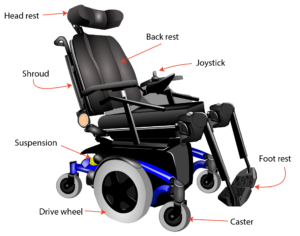
A typical power wheelchair includes a metal frame containing a motor and battery, a seat with a backrest, footrests, small caster wheels in the front and/or back, and two large rear wheels at the back. It is propelled and maneuvered using a joystick or other control function.1
Power wheelchairs are mobility devices powered by a battery and motor, and operated by the user or by another person, such as a caregiver. Power wheelchairs may be controlled in a number of different ways: by hand using a joystick, by head movements through head array systems, by the breath through sip-and-puff controllers, and by other specialty controls. This allows power wheelchairs to be used by individuals with high cervical SCI.
Power wheelchairs are typically used by those with limited control of the muscles at the elbow (complete injuries above C5) or other reasons which make it difficult to propel a manual wheelchair. Additional factors that may encourage the use of a power wheelchair over a manual wheelchair include:
- Improved independence (if the individual is unable to effectively propel a manual wheelchair)
- Avoidance of overuse injuries
- Increased speed (if the individual has weak upper body strength)
- Lengthening the amount of time that a person can spend in the wheelchair
- Improves the ability to participate in important activities more easily