
How is orthostatic hypotension diagnosed?
Author: SCIRE Community Team | Reviewer: Darryl Caves | Published: 9 April 2018 | Updated: ~
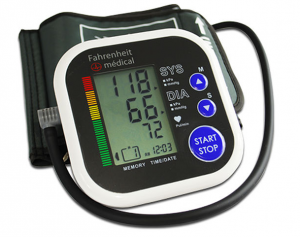
Blood pressure reading from a blood pressure monitor.9
To diagnose orthostatic hypotension, blood pressure is first measured while in a lying or sitting position and then again in an upright or standing position. The two blood pressure readings are compared to see if there is a drop in blood pressure. Other times, severe symptoms alone (such as fainting) may be used to diagnose orthostatic hypotension.
Since many people with SCI cannot stand, blood pressure can be assessed based on a lying then sitting position instead. A tilt table or other supportive device can be used to assist with getting upright.
How to interpret blood pressure readings
The heart contracts and relaxes as it pumps blood throughout the body. A blood pressure reading usually shows up with two numbers:
- The systolic blood pressure is the blood pressure when the heart contracts. It is usually the first of the two numbers (i.e. ‘120’ when someone says ‘120 over 80’).
- The diastolic blood pressure is the blood pressure when the heart relaxes. It is usually the second of the two numbers (i.e. ‘80’ when someone says ‘120 over 80’).
Orthostatic hypotension is diagnosed when there is a decrease of at least 20 mmHg in systolic blood pressure or a decrease of at least 10 mmHg in diastolic blood pressure after moving from lying or sitting to standing.
