
What maintenance and checks should be done for a manual wheelchair?
Author: Sharon Jang | Reviewer: Ian Denison | Published: 3 January 2025 | Updated: ~
Several parts of a manual wheelchair may require maintenance. We discuss these maintenance checks below. If you find anything wrong with your wheelchair, contact your wheelchair service provider.
Weekly maintenance
Tire inflation
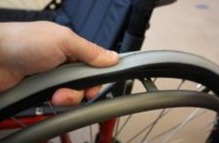
To maximize pushing efficiency, it is important that your tires are always properly inflated. Weak research evidence suggests that tires deflated by more than 50% result in using more energy when pushing. However, it must also be noted that softer tires perform better on soft surfaces, such as grass or gravel. For general daily use, tires should always be inflated to the recommended values indicated on the side of the tire.
There are two ways to check tire pressure:
- For a more accurate reading, use a standing bicycle tire pump with a gauge.
- If you do not have a pump with a gauge, press down firmly on your tire with your thumb. If it presses in at all, it requires inflation.
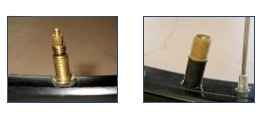
Types of valves: Presta (left), Schraeder (right)
The amount of air required for your specific tire is indicated on the side of your tire. To inflate your tire, a standing pump, a gas station pump, or a hand pump may be used. Note that most hand pumps are not able to inflate tires over 50 psi; a high-pressure hand pump is required for tires. In addition, gas station pumps are only able to pump up Schraeder valves as Presta valves require an adaptor.
Cushion
Your cushion is essential to maintaining a good seated posture and for skin health. To ensure that your cushion is in its best shape, inspect the cushion and cover on a weekly basis. When inspecting the cushion cover, look for any holes, signs of wear, or flaking on the underside of the cushion, and make sure the zipper is working properly.
Maintaining your cushion depends on what kind of cushion you have:
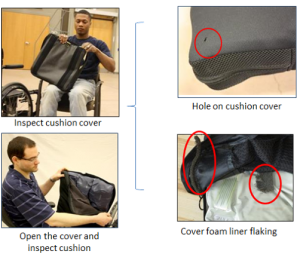
For gel cushions: knead the gel from outside to inside. Ensure that the gel is redistributed, and that gel is present under areas of high pressure (e.g., in the area of your sit bones). In addition, ensure that there are no leaks in your cushion.
For foam cushions: check that the foam is not breaking down or crumbling anywhere.
For air cushions: ensure that your cushion is properly inflated. Check for leaks. If you think your cushion may have a leak, submerge it underwater and check for bubbles.
Monthly maintenance
Cushion and cushion cover
Keeping your cushion clean is important, as dirt on the cushion may lead to skin breakdown, and may leave a smell on your cushion. Once a month, wipe down the cushion with a clean damp cloth and soap. Wash the cushion cover in a washing machine, and follow the instructions in the cushion guide. Make sure to hang dry the cover, as placing the cushion cover in the dryer may result in shrinkage which may result in the cover being too small for your cushion.
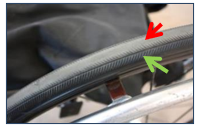
Intact (green) and worn out (red) tread on a wheelchair tire.15
Tires
The tires are a key component of the wheelchair subjected to daily wear. Inspect your tires once a month to make sure they are in good shape. Look for any signs of wear, cracks, bulges, looseness, damage, or flat spots.
Wheel bearing
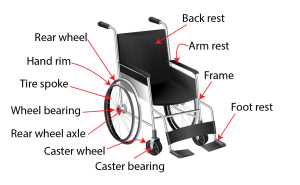
The wheel bearings are located within the hub of the rear tire, and help to allow the wheel to turn freely and smoothly. Bearings normally wear out over time with use. You will know it is time to replace a bearing if you start hearing a knocking, or more infrequently, a squeaking sound as you wheel. If you suspect that you need your wheel bearing replaced, contact your local wheelchair service provider.
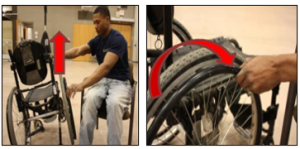
The wheel bearing should be tightened to a happy medium: a wheel bearing that is too loose may result in side to side movement of a wheel, while a wheel bearing that is too tight may result in additional resistance, resulting in an increased amount of energy spent while using your wheelchair. To check that the wheel bearings are not too tight or too loose, lift one side of the wheelchair up and spin the wheel. The tire should spin easily and should not slow and stop quickly after being spun. After the wheel stops spinning, it should spin backwards a little and should not wiggle side to side too much.
Large wheel axle
Rear wheels may be fixed (i.e., not removable) or quick release (i.e., removable). To ensure that the wheels are in place and are not loose, wiggle the wheel in all directions. If you have a fixed axle, there should be no play in the wheel. If you have a quick-release axle, some play is acceptable.
If you have a quick-release axle, test the release mechanism and ensure that the wheel securely locks back in place. A wheel that does not latch back in securely may result in an accident and should be addressed as soon as possible.
Wheel alignment – wheelchair tracking
When looking at your wheelchair from above, the two rear wheels should be parallel to each other. Having wheels that are misaligned may result in greater energy expenditure and veering of the wheelchair when pushing. Needing to constantly correct for a veer when pushing may result in reduced control over the direction that a wheelchair is moving in, a strain on one arm and/or an increased use of energy.
To check whether your tires are aligned, roll through a puddle of water and allow the wheelchair to coast. The wheelchair should maintain its direction, and the tracks of the chair should be straight.
Spokes
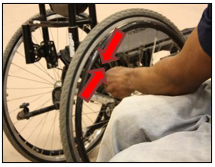
Spokes are attached from the wheel rim (outer part of the wheel) to the hub (center part of the wheel), and help to distribute the forces of wheeling, such as the weight of the user, wheeling over surfaces, and braking. The spokes on a wheel act to prevent the tire from collapsing and adds stiffness to a wheel by acting as an anchor for the hub of the wheel.
When inspecting your spokes, you want to check that none of the spokes are bent and that there is enough tension in the spokes. Having enough tension in each of the spokes is particularly important, as having one loose spoke will lead to others becoming loose. Signs of loose spokes include a faint metallic snapping sound as you move. To check tension in the spokes, you have two options:
- Squeeze the spokes in pairs around the entire wheel. If a spoke gives when being squeezed gently, it may be loose.
- The ping test: spin the wheel and hold a pencil against each spoke. You should hear a normal pinging sound. Any spoke that sounds off indicates a loose spoke.
Wheel locks
Casters
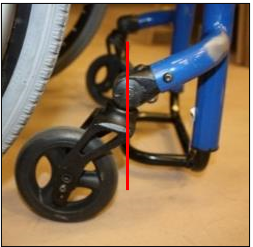
Caster stem that is not aligned with the caster wheel.19
Casters are the small wheels found on the front of the wheelchair that help to stabilize the wheelchair. Begin by inspecting your casters for wear, cracks, looseness, tears, and bulges.
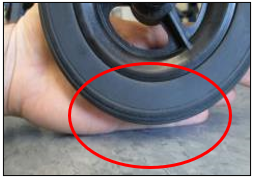
An example of a floating caster. Note the space between the bottom of the wheel and the ground.18
Secondly, to ensure that the casters are effectively stabilizing the wheelchair, check that both caster wheels are in contact with the floor and that the caster stem is aligned vertically. As the casters are required for maneuvering, it is important to ensure that they are able to turn freely around the axle. Check the casters for fluttering, or a shimmy/rapid vibration of the casters when moving.
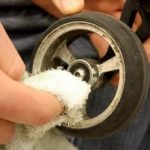
Clean the caster wheel. Remove any dirt, lint, or hair that may have been collected in the caster axle using scissors, pliers, or tweezers. Further, clean the caster using a clean damp cloth or with a toothbrush.
Caster bearing
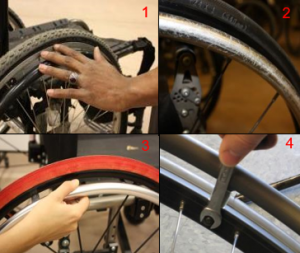
1. Inspect for wear. 2. An example of a handrim with scratches. 3.Inspect the tightness by pulling out on the hand rim. 4. Tighten as necessary.21
Like the rear wheel, casters consist of wheel bearings to ensure smooth rolling. To check that the bearings are at a happy medium in tension, spin the caster wheels and the caster assembly, and push the caster side to side. Grinding and excessive play in the caster bearings are indicative of a problem.
Handrim
The handrims are rings connected to the rear wheel by bolts, and are used to propel the wheelchair. Most handrims are made out of plastic or metal (e.g., aluminum, steel), and may be coated in vinyl for extra grip. It is recommended to inspect your handrims monthly for wear, dents, cracks, or bends – they should be smooth all around. In addition, make sure that the hand rims are not loose. If loose, try tightening the bolts that connect the handrims to the wheel.
Frame
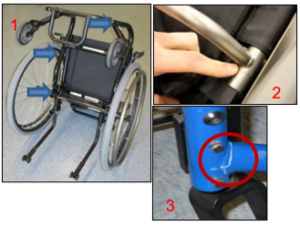
1. Common weld points.
2. Inspect the weld points.
3. Example of a cracked weld.22
Wheelchair frames consist of a series of metal tubes that have been welded together. Each month, check the welds to make sure that the tubes are held together. Inspect the frame for cracks or fractures. In addition, wipe down the frame each month with a clean damp rag. A toothbrush may be used to remove more difficult dirt. Avoid using a hose, power washer, or washing your wheelchair in the shower as it may cause the bearings to rust.
Nuts and Bolts
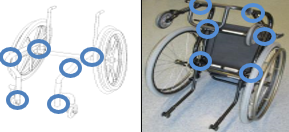
Common sites of nuts and bolts on manual wheelchairs.23
There are many nuts and bolts used on a wheelchair to hold various parts together. Loose nuts and bolts on your wheelchair may not only lead to rattling noises, but may not hold the part correctly and may fall out. Check the nuts and bolts on your wheelchair, and tighten them if loose. Make sure not to over tighten the nut or bolt, as it could damage the part or increase wheeling resistance.
Backrest
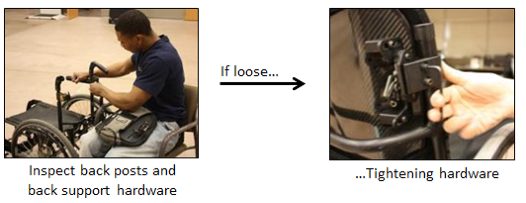
As the backrest is used to support your sitting posture and can impact your skin health, it is important to check that it is in good shape. To do so, check the upholstery for tears, wear, stretching, or metal parts that have poked through. If you have a rigid back, check that the backrest does not wiggle and is tightly secured. In addition, make sure that the backrest height is level. It is possible for a backrest bracket to become loose, resulting in one side of the backrest being higher than the other.
If you have an adjustable sling back, observe the tension of the backrest as it may stretch over time. Adjust the back as needed.
Foot support
The foot support is often the first part of the wheelchair that comes into contact with obstacles. For example, it may be used to help open doors, act as bumpers, and may be scraped along the ground. As the foot support is used to help maintain posture, it is important to keep it intact. Inspect the footrest to ensure that it is not loose. If you have swivelling foot rests, ensure that they swing away with ease, and can latch back properly. Also be sure to check the footrests for wear on the pins, bolts, and bushing, and tighten these parts if necessary.
