
How are pressure injuries diagnosed?
Author: SCIRE Community Team | Reviewer: Susan Andrews | Published: 3 November 2017 | Updated: ~
To identify a pressure injury early you need to check your skin once or twice daily using a mirror or with the help of a care provider.
Physical examination
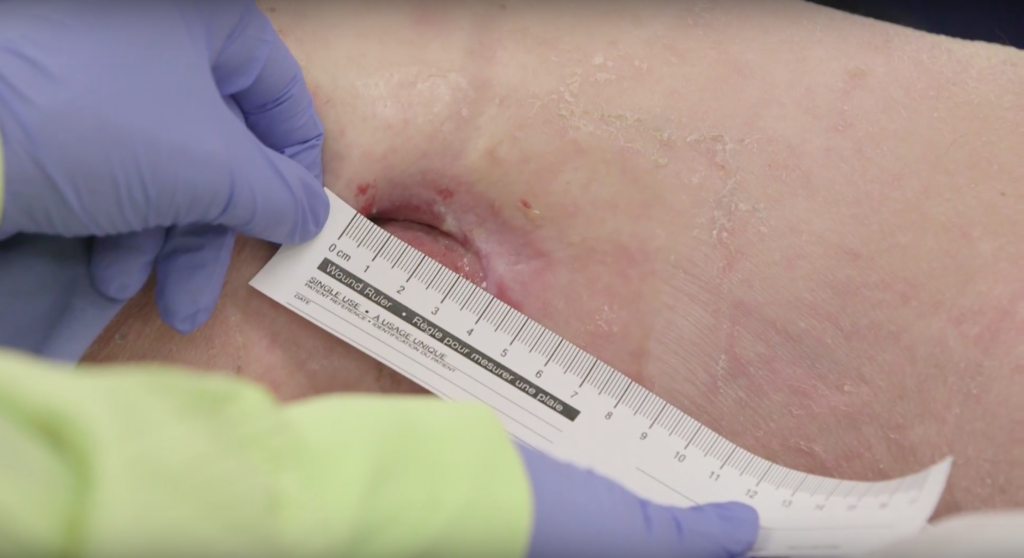
Wounds may be measured and photographed to keep track of changes over time.7
The main way that pressure injuries are diagnosed is with a visual skin check. Checking by feel is not enough, because it only identifies open areas that can be felt. Early pressure injury can be as simple as red or purple discoloration to the skin.
If there is an open wound you may need to be seen by a physician and referred to a nurse for a wound assessment. This may involve starting a treatment plan that should include trying to identify the cause of the pressure injury.
The nurse will observe the wound and take note of its appearance (such as its edges, colour, and shape) and look for signs of inflammation or infection. The nurse may take measurements of the length, width, and depth of the wound. These can help determine the stage of the wound and be used as a comparison as it heals. Sometimes, the nurse may take photos for assessment purposes. A swab of the pressure sore is only taken if infection is suspected. Infection is suspected if there has been increased redness, odour or drainage or if pain has increased if you have sensation.
It is often helpful to have an occupational therapist or physiotherapist involved to help figure out the cause of tissue damage.
Listen to Josh describe his experience of having a pressure sore he wasn’t aware of and how he overcame it with the help of a specialist.
Other testing
- Blood tests may be used to identify if there is an infection.
- Ultrasound is an imaging technique that may be used in some facilities. Ultrasound imaging uses sound waves to detect injuries deep within the skin. It may be used to detect suspected pressure injuries that are not easily seen.
Osteomyelitis (bone infection)
When pressure injuries are severe and reach all the way to the bone (stage 4), there is a risk of developing a serious bone infection called osteomyelitis. If your health team is concerned that you might have osteomyelitis, you may have additional testing such as x-rays, an MRI, or blood tests to diagnose this condition.