
What is nerve transfer surgery?
Author: Kelsey Zhao | Reviewer: Michael Berger, Christopher Doherty | Published: 23 January 2024 | Updated: ~
Spinal cord injury (SCI) disrupts the nerve pathways that send signals between the brain and muscles. This disruption can lead to loss of muscle strength and movement.
Nerve transfer surgery aims to restore some movement to a paralyzed muscle by connecting a nearby functional nerve from above the SCI to the non-functional nerve of the paralyzed muscle. The paralyzed muscle and its non-functional nerve are called the recipient. The functional nerve transferred to the recipient is called the donor. The donor nerve used is expendable (i.e. removing the nerve does not cause any significant loss of movement) or taken from an area where there is more than one muscle that performs the same movement. Over time and with rehabilitation, the healthy cells of the functional nerve will use the non-functional nerve as a scaffold to grow towards the paralyzed muscle. This creates a new pathway for signals to travel between the brain and the muscle.
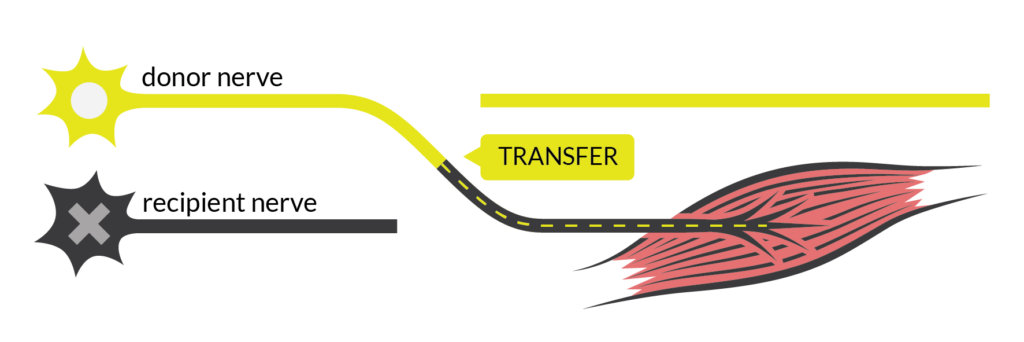
Nerve transfers involve the transfer of a functional donor nerve to a non-functional recipient nerve to create a new signal pathway to a paralyzed muscle.1
