
What are the components of a manual wheelchair?
Author: Sharon Jang | Reviewer: Emma M. Smith | Published: 3 March 2020 | Updated: ~
A typical manual wheelchair contains a frame, seat with a backrest, footrests or footplate, two small caster wheels in the front, and two large rear wheels at the back. The rear wheels contain hand rims which are used to propel and maneuver the wheelchair. Wheel locks on the rear wheels help prevent the wheelchair from moving when it is not in use or when getting in or out of it.
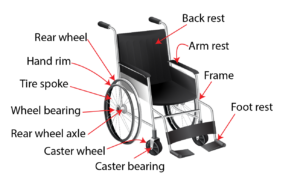
There are many different styles of manual wheelchairs, most of which allow for the ability to adjust and change aspects of the set up. This can be important in the first few years that a person uses a wheelchair as a person’s skills and priorities may change. Nonetheless, it is important to try to get as lightweight and compact a wheelchair as possible while also ensuring it is safe, durable and flexible.
There are many different components of manual wheelchairs that can be customized and changed to find the best set-up for an individual. Below, we list some of the common options and changes that may be possible when setting up a manual wheelchair. In general, changes to the set-up of the manual wheelchair are a series of tradeoffs. Although changes are usually intended to achieve a desirable improvement (such as greater ease of wheeling), sometimes they need to be balanced with reduced stability and an increased risk of tipping over. Please speak to your health providers before making any major changes to your wheelchair set-up.
Frame design
Manual wheelchairs come in two basic frame designs, folding frames or rigid frames. Folding frames have a crossbar under the seat that allows the frame to fold in half. Rigid frames may also fold but in a different way, where the backrest folds down. In many manual wheelchairs, wheels can removed if they are being put in a vehicle.
Folding manual wheelchairs
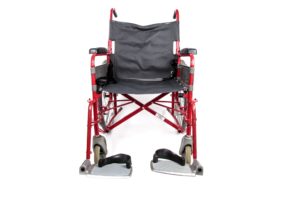
Folding wheelchairs are designed to be folded vertically and take up minimal storage space. This allows for easy portability (such as fitting the wheelchair into a car). However, these wheelchairs also have many moving parts that may break down or loosen over time, and are heavier than rigid wheelchairs. Folding wheelchair often have flip up, swing away or swing in footrests so they may be used by individuals that do not use the wheelchair full time, can stand or take some steps, or by those who foot propel.
Rigid manual wheelchairs
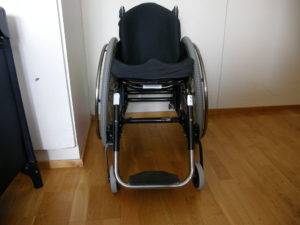
Rigid wheelchairs tend to be lighter and more durable than folding wheelchairs, which makes them the common choice for people with complete SCI injuries. The rear tires often have to be removed to fit into a vehicle because they cannot fold inward. Some rigid manual wheelchairs can still be ordered with adjustability, which can be important if seating components change.
Frame materials
The majority of manual wheelchair frames are made of either aluminum or stainless steel. Ultralight and sports wheelchairs are often constructed from high performance aluminum, carbon fiber, chromium-molybdenum, nickel alloy steel, or titanium. Titanium and composites can be considerably more expensive but are more lightweight.
Seat width, depth and slope
It is important that the width, depth and slope (also known as dump) of the seat from front to back are well-fitted to the overall function and characteristics of the user. A wheelchair that is too narrow in width may cause skin problems due to rubbing, while a wheelchair that is too wide may hinder propulsion, and will interfere with the accessibility and maneuverability of the chair. A wheelchair that is too short in depth may provide insufficient support to the hips and stability to the bottom, while a wheelchair that is too long in depth may cause knee pain or a slouching posture. In addition, an increased seat slope (i.e., one that is higher in the front than the back) makes transfers more difficult as one would need to lift up at an incline, but are better for people with a higher level of injury because this slope helps them find balance and stability to wheel.
Footrest angle and frame taper
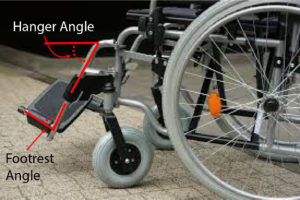
The footplate is angled away from the frame of the chair and the post of the casters.6
When considering the footrest angle between the seat and the footplate hanger, the knee flexion range of movement and hamstring length needs to be considered as well as the visual field as the client may not be able to see their feet. For example, a greater frame angle improves wheelchair access by making the chair shorter but may make the chair more unstable in the forward direction. Some wheelchairs have a frame taper, which is the narrowing of the frame towards the front and continues down to the footplates. This improves access from the front of the wheelchair, making toilet transfers easier. However, the taper may not be compatible with the cushion and may impact the ability of the wheelchair to fold.
Rear Wheels

Spoked wheels (left) versus mag wheels (right).7,8
The rear wheels are set up with hand rims on them so that self-propelling is possible. Wheel material and the amount of air in the wheels affect how effective the wheels are in minimizing vibration or shock to prevent triggering of spasticity and to increase comfort. Wheel rims are made from a variety of materials including aircraft grade aluminum, plastic, fibreglass, reinforced nylon, titanium, carbon graphite, or steel. Types of rear wheels include: spoked wheels (made of metal, normally has more than 30 spokes), mag wheels (made out of synthetic material, less than 10 spokes), carbon-graphite mag wheels, and power assist wheels. The more spokes, the better the vibration absorption. The most common wheel size for adults is 60cm (24”) and for children it is 50cm (20”).
Tires
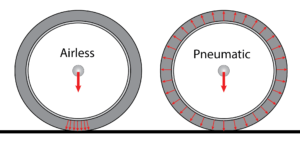
Airless (solid) tires tend to provide bumpier ride.9
Wheelchairs may have solid tires, foam-filled tires, or air (pneumatic) tires. Solid tires do not run the risk of popping, however, they often result in a bumpier ride. On the contrary, air tires provide a softer ride, but require regular maintenance of air pressure. A lack of air in the tires (less than 50% of the recommended PSI) makes propelling a wheelchair more difficult. It is recommended that tires be re-inflated every two months to keep the pressure above 50%. Some type of tires include: standard pneumatic tires, high pressure pneumatic tires, outdoor pneumatic tires, puncture proof tires, and solid plastic tires.
Hand rims/Push rims
Hand rims are attached to the rear wheel rim on wheelchairs that are intended for self-propulsion. This part is optional, and some users may opt not to use them. Hand rims are commonly made out of aluminum, and may be anodized or vinyl coated. Some downsides to using aluminum hand rims are that they may turn your hand black, and can become very sharp if they are damaged. Other models of hand rims have a rubber like material and assist individuals without full handgrip with their push stroke. In addition, flexible hand rims have been developed to adapt to the shape of the hand in order to reduce strain resulting from the bending action of the wrist and fingers.
Front caster wheels
The small front wheels are called caster wheels, and they help maneuver and steer the position of the wheelchair. Caster diameter, material, and position are important factors to consider that affect wheelchair balance and performance. Sizes available include 75mm (3”), 125mm (5”), 150mm (6”), 180mm (7”), 200mm (8”), and 250mm (10”). Bigger caster wheels are more stable, have a bigger turning radius, and easier to wheel over thresholds but are less maneuverable and responsive. A point of caution is that when caster wheels are trailing, a person’s weight will be more forward and may be in front of the caster wheel, which can cause tipping and is a frequent cause of falls in manual wheelchairs (see image below). Caster stem angle must always lie at right angles to the floor to ensure casters track correctly, or they may “flutter” when the wheelchair is pushed or can cause the front of the wheelchair to rise and fall during turning.
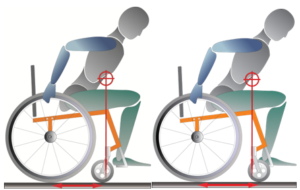
Forward casters (left) versus trailing casters (right).11
When choosing the type of caster, one should consider the most common type of surface they will be propelling on (e.g. outdoors or indoors), the desired front seat height, and the front frame angle of the wheelchair. The construction materials available for caster wheels include plastic, urethane and aluminum. Pneumatic caster tires, usually 150mm (6”)” and 200mm (8”) in diameter, have more shock absorption features making them ideal for outdoor wheeling, while 75mm (3”) and 125mm (5”) urethane caster tires are more common and are good for indoor propulsion and sport specific wheelchairs. Those who experience significant spasticity and/or discomfort when propelling wheelchairs often opt for pneumatic casters to achieve a smoother ride.
Wheel locks
Wheel locks are used on the large rear wheels for safety with transfers and when no movement is wanted. They vary in styles including push to lock, pull to lock, and scissor style locks. To decrease the force required to engage/disengage the wheel locks, extended brake levers can be applied, as they minimize the forward reach required to access the wheel locks. The type and position of the lock should be influenced by the user’s reaching ability, balance, strength, and hand function as well as the impact of wheel lock position on transfers. Some clients with good physical skills may not even require wheel locks at all.
Anti-tippers
Anti-tippers are an optional set of smaller wheels connected to a metal poles that are attached to the frame of your wheelchair 381 to 508mm (1.5 to 2″) above the ground. Anti-tippers are commonly found on rear of the chair to prevent a backwards fall, however they can also be found on the front of the wheelchair to prevent forward tipping. Anti-tippers may be especially useful for new wheelchair users, those who have recently switched to a new wheelchair, or if one’s health is declining. While they are considered a safety item, they also have drawbacks. Firstly, anti-tippers may interfere with wheelchair skills requiring you to lean backwards, such as climbing a curb or doing a wheelie. Secondly, if the anti-tippers are set too low, it may impede on going over obstacles or up hills.
