
How do nerve transfers compare to tendon transfers?
Author: Kelsey Zhao | Reviewer: Michael Berger, Christopher Doherty | Published: 23 January 2024 | Updated: ~
Tendons are rope-like bands that connect your muscles to your bones. In a tendon transfer, the tendon of a healthy muscle with functional nerves is cut and attached to the tendon of a paralyzed muscle. This transfer allows the working muscle to take over the movement of the paralyzed muscle. This is another way that movement can be restored in the arm or hand for someone with tetraplegia.
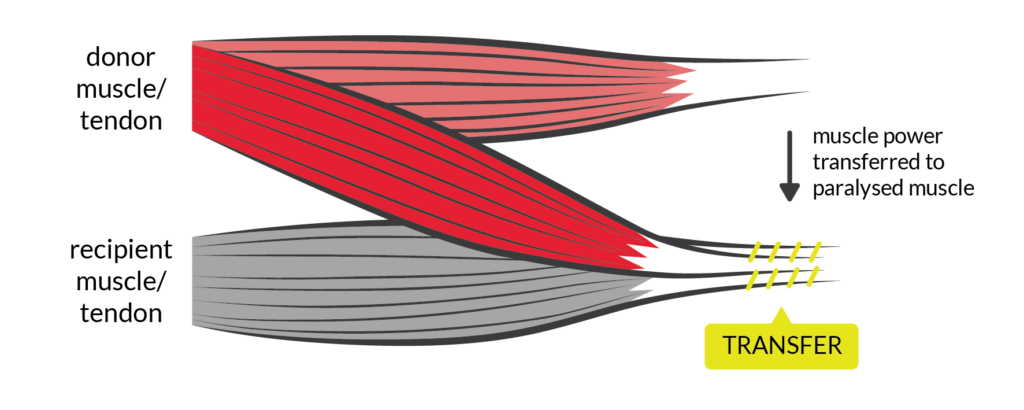
Tendon transfers involve using a working muscle to power a paralyzed muscle movement by transferring the tendon of the working muscle to the paralyzed muscle.10
Nerve transfers and tendon transfers can also be used in combination to restore movement. Patients in one study who underwent both nerve transfer and tendon transfer reported no preference because each was beneficial in a different way. Hands with nerve transfers resulted in more natural and dexterous movement, and hands with tendon transfers felt stronger. Each has characteristics that make the procedure more or less suitable for an individual depending on their injury, timing, and recovery goals.
Table 2: Comparison of nerve transfers and tendon transfers
Nerve Transfer |
Tendon Transfer |
|
What kind of movement is improved? |
More precise, controlled movements that do not require as much strength. | Stronger movements that do not require as much precise coordination. |
What kind of activities could this surgery help with? |
• Using devices like a phone, keyboard, mouse, or touchscreen. • Social interactions like a handshake or hug • Eating and drinking independently • Holding light objects • Pressure relief movements • Some self-catheterization steps |
• Lifting and holding heavy objects • Wheelchair pushing and maneuvering • Eating and drinking independently • Dressing • Improved transfers • Personal hygiene • Writing |
When can I get this surgery? |
Depending on your injury, this surgery is usually done around 6 months after SCI, or could be done years later in some cases. | Any time after SCI. |
How long does healing take? |
You can do light activities immediately after surgery while your skin heals. You can return to normal activities after 2-4 weeks. Avoid weight-bearing, repetitive, or straining activities for 1 month. |
A splint and cast will be used to immobilize your arm for 1-2 months while the tendon heals. Avoid weight-bearing activities and sports for 2-3 months. Some centres may start physical/occupational therapy exercises days after surgery, during the immobilization period. |
How long will rehabilitation take? |
Daily exercises at home and physical/occupational therapy at least once per month for 2 years. | Approximately 3 months Physical/occupational therapy helps you to learn the new movement and makes sure the tendons heal properly. |
How long will it take to see movement? |
First improvements in movement usually happen between 3 to 12 months, depending on the type of nerve transfer. There are accounts of initial movement recovery as late as 2.5 years after surgery. Research shows that movement may continue to improve for years after surgery. |
Improvements in movement usually occur between 1-3 months after surgery. Research shows that movement may continue to improve for up to 12 months after surgery. |
