
What is autonomic dysreflexia?
Author: SCIRE Community Team | Reviewer: Andrei Krassioukov and Janice Eng | Published: 12 October 2017 | Updated: ~
Autonomic dysreflexia (also called autonomic hyperreflexia) is a potentially life-threatening medical condition that can happen after spinal cord injury. Autonomic dysreflexia involves a sudden rise in blood pressure accompanied by changes in heart rate and other symptoms like headaches and sweating. The blood pressure responses in the body are poorly controlled because of the SCI and can become dangerously high.
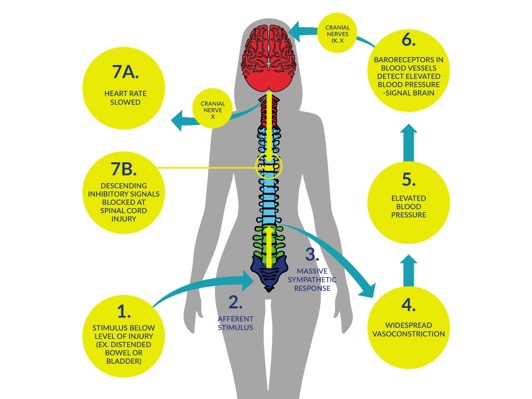
Pathophysiology of autonomic dysreflexia.1
Autonomic dysreflexia typically affects people with SCI at T6 and above (although occasionally as low as T8). In general, people with higher
level of injury
and
complete injuries
are more likely to experience autonomic dysreflexia. Autonomic dysreflexia can occur at any time after the SCI.
