
What parts of a power wheelchair should I know about?
Author: Sharon Jang | Reviewer: Emma M. Smith | Published: 4 March 2020 | Updated: ~
Drive controls
Drive controls for power wheelchairs come in a variety of forms and they are chosen depending on the physical capabilities of the user. Joysticks are used if you have enough arm movement to drive the wheelchair. There are different styles of joysticks available for use, depending on your hand function. This may include ball shaped controls, knob shaped both large and small, stick shaped, as well as U-shaped to name a few. Selecting an appropriate joystick according to your abilities will provide control and precision when driving. For people without the strength or endurance to drive with their arms they may choose to drive with their head, chin or use their mouth with a sip and puff control that is controlled by breath.
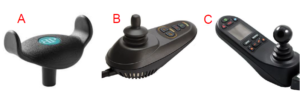
Various types of joystick controllers include U-shaped (A), stick (B), and ball (C).5-7
Novel drive systems
With the advancement of technology, more unique drive systems are becoming available to accommodate for a range of abilities. Recently, there has been emerging evidence for:
- Tongue drive systems: This new system allows individuals to drive a power wheelchair with their tongues. For this to work, an individual will need to have their tongue pierced and have a titanium magnetic barbell fitted. Once in place, the user will wear a headset with magnetic sensors. This allows for individuals to move their tongues to certain teeth/spots in their mouth to drive their chair.
- Eye gaze systems: This system uses an eye tracking device, which allows the user to drive a powered wheelchair with their eyes. To maneuver, the user simply looks left to go left, looks right to go right, and blinks for 1 second to start or stop the wheelchair. Weak evidence suggests that users are satisfied with the system and that it may be feasible to accurately drive a wheelchair with the eyes.
- Facial drive systems: New programs allow individuals to drive their wheelchair with various facial movements/emotions as they choose. This includes movements including raised eyebrows, head movement to the left/right, or head movement up/down.
Ultimately, we must note that the tongue drive system is very new, and more research will need to be conducted before its use in practice.
Positioning functions
Power wheelchairs can have the added function of repositioning the SCI user. Repositioning helps shift weight to other parts of the body. This is helpful in providing comfort, supporting posture, and lessening pressure on certain parts of the body.
Tilting
Tilting a power wheelchair maintains the hip and knee angles by shifting both the seat and backrest together. This reduces the chances of rubbing on the skin when moving between positions. Generally, tilting with a power positioning device to a minimum angle of 30° is needed before the beneficial effects of weight shifting can be obtained, while a 55° tilt has been recommended. Additional benefits of tilting include assisting with respiratory function, providing a more comfortable position to rest in without having to transfer to a bed, and increasing stability and balance when travelling on uneven surfaces (e.g., hills).
Reclining
Reclining a power wheelchair consists of the backrest moving backwards/downwards while the seat remains stable. This increases the angle between the seat and the backrest. Some benefits of reclining include stretching out the hips, facilitating toileting and changing catheters, and facilitating transfers for caregivers. There is some weak research evidence that suggests that reclining to 120º may help reduce the pressure applied by the buttock, but reclining back this far also increases the amount of rubbing, which can lead to sores.
Repositioning and pressure sores
One recommended strategy to prevent the development of pressure sores includes weight shifting. Relieving weight off the buttock may help prevent pressure sores by allowing the tissues under pressure to regain blood flow. This is normally done using strategies such as leaning forward or lifting off the seat. If you have a higher level of injury, you may not be able to relieve pressure off your buttock independently. This is where the tilt function of a power wheelchair can come in handy – tilting backwards may help reduce the pressure applied on your bottom and allow for proper blood flow to occur. For more information on pressure relief and sores, check out our page on pressure sores.
Standing
Some wheelchairs can support standing in people with SCI. Not only does standing decrease pressure at the sit bones and coccyx, it also provides many other physiological advantages such as maintaining bone mass density, improving circulation, and enhancing functional tasks such as reaching for items on a shelf. It can also be helpful in managing spasticity and for social interaction or certain job functions.
Elevation
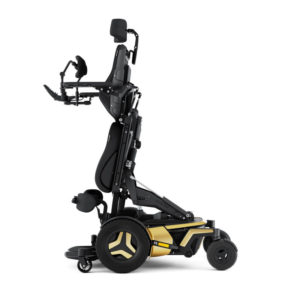
The elevation function of a power wheelchair raises the height of the seat. This is an option that can be added to the chair to enable individuals to reach and access things independently or without shoulder strain. It can also improve social interaction enabling the wheelchair to move to a height where they do not have to look up or be blocked in a room full of people.
Arm rests
Arm rests are multifunctional pieces that are located on the sides of the wheelchair. First, arm rests act as a support for the arm and the shoulder. When in motion, the arm rest help with balance during sudden stops, going up/down hills, and with balance in general. In addition, swelling in the arms may be reduced when the arms are kept elevated. Resting arms on the arm rest may also help maintain upper body posture as the weight of the arms is supported (versus hanging and pulling the upper body downward).
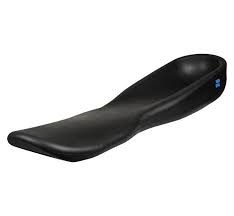
Individuals with cervical level injuries may require a specialized shaped armrest to provide support. 12
Secondly, arm rests can act as a source of stability when weight shifting to relief pressure. Individuals with a SCI can use their arm rest to push themselves up when shifting, or use the arm rest to act as a stabilizer when shifting their weight. For someone who adjusts their position often, gel padded arm rests may be used to increase comfort and support.
Arm rests can be highly adjustable based on various needs.
- Having an arm rest that is too high up may push up the shoulders and may be uncomfortable
- The use of adjustable arm rests may be helpful if the individual wants to be able to pull up to a table
- Some arm rests come with a side panel built in to provide thigh support
- Some arm rests have the function to be flipped up, while other types of arm rests may be completely removed from the wheelchair
- A removable arm rest may be used to help facilitate transfers
Additionally, arm rests for individuals with injuries C4 or above may require special adjustments. Arm troughs (or a more formed arm rest) may be used to provide additional support to the arm to prevent it from moving. In addition, elbow blocks may be used to help support an upright position when tilting. In the case that an individual experiences spams in the arm, sheepskin or gel pads may be used to protect the skin when the arm rests in the trough.
Foot rests: footplates and leg rests
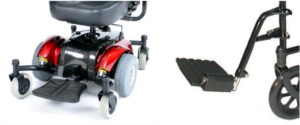
A footplate is generally a single plate (left), while foot rests consist of individual pieces (right). 13,14
Depending on the drive mode, power wheelchairs may have a footplate or leg rests. A foot plate is often connected to the base of the power wheelchair, and is one piece of metal that can be flipped up and down and supports both of the feet. In contrast, leg rests are two separate supports for each foot.
Where the foot rest sits is dependent on the drive base and the physical characteristics of the person. A rear wheel drive wheelchair has footplates the furthest away from the chair as there are caster wheels located on the front. This results in added length to the wheelchair, which may make it harder to turn. The use of a single centre-mounted footplate may help reduce the length of the wheelchair. Front wheel drive wheelchairs do not have front casters that interfere with the foot rests, as the caster wheels are located in the rear. As a result, the foot rests on front wheel drive wheelchairs do not interfere.
Some power wheelchairs may have an option for powered footrests, allowing the user to adjust the angle of the footplates through a motor. To prevent the legs from dangling when using the tilt or recline function, some power wheelchairs may have a foot rest elevation function. This function helps to increase the height and angle of the foot rest to elevate the legs when reclining, and lowers back into the default position when returning to an upright position.
