
How can I adapt exercises?
Author: Sharon Jang | Reviewer: Sonja de Groot | Published: 20 April 2022 | Updated: XX October 2024
Watch SCIRE’s YouTube video explaining how to adapt exercises.
Going back into a gym after an SCI may be daunting given that much of the equipment may no longer be accessible. However, there are a number of ways to adapt gym equipment, including grip assistance, transfer boards, chest straps, and using free weights and wedges. When exercising at a gym, you may require some additional assistance getting set up on pieces of equipment. If this is the case, consider going with a family member or a friend, and don’t be afraid to ask the gym attendant for help.
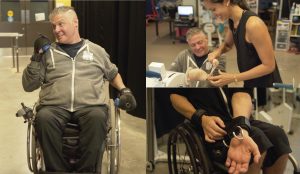
Adaptive grip aids include commercial gloves (left), tensor bandages (upper right) and weight lifting cuffs (bottom right).
After a high-level SCI, hand functioning may be impaired, resulting in a lack of ability to grip. To address this in a gym setting, some available options include using tensor bands, commercially available gloves, or weight-lifting cuffs. Tensor bandages can be used to wrap your hands around a handlebar. Benefits of using a tensor bandage include wide availability and low cost. Commercially available gloves, such as the Active Hands, are also available to assist with grip function on handles. These gloves provide a bit more support to the wrist and have a Velcro strap around the wrist. They also have a second Velcro that goes over the hand, which secures the hand to the handle. However, commercial gloves may not be as readily available and are usually expensive. Lastly, some individuals use weight-lifting cuffs, which are available at most gyms for use, to assist with grip function. These cuffs have a Velcro strap that goes around the wrist and a hook that can be connected to handlebars. Although commonly found in gyms, weightlifting cuffs only work for specific movements, such as pushing and pulling. In addition, they might not fit around handles of all sizes.
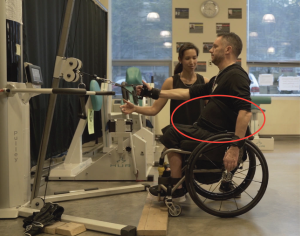
An abdominal binder (circled in red) being used to help keep an upright posture during rowing.
Abdominal (core) function is often impacted with an SCI, which may limit the types of activities you are able to do. One way to address this issue is through the use of a chest strap. A chest strap is a neoprene strap that comes in differing widths but is often wide enough to cover your abdominal area. The idea is to wrap the chest strap around the backrest of your wheelchair and around your torso, preventing you from falling forward if you are doing a pulling exercise. Chest straps are commonly used in various wheelchair sports as well, to provide additional support.
When exercising in a wheelchair, you may find that the wheel lock still allows for some movement in the wheels, which may hinder an exercise. One way to address this situation is through adding additional support at the base of the wheel using wedges or free weights. Free weights can be placed behind the rear tire on both sides, or in front of the rear tire on both sides. In place, small wooden wedges (or door stoppers) can be placed under the tires on all four sides (in front and at the back) to help prevent rocking.