
What renovations can I make to my home to make it accessible?
Author: Sharon Jang | Reviewer: Rachel Abel | Published: 25 May 2022 | Updated: ~
There are many features that can be included or added to a home to make it more accessible. Below, we list some ways homes may be adapted. This list is not exhaustive. It is important that you discuss things with peers, and experts in home design/building to see what works best for you and your home. For more photos, please refer to SCI Saskatchewan’s Accessible Housing page.
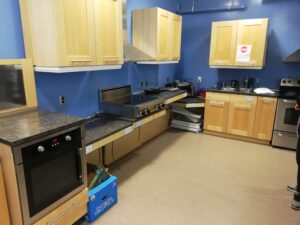
In the kitchen above, note the stove dials on the front of the stove, the lowered sink, and the space to wheel under it.9
Kitchen
Kitchens can be inaccessible after SCI due to the inaccessibility of stoves, a lack of leg space under counters, and counters and sinks being too high. Some modifications that can be made in the kitchen include:
- Putting in lowered countertops.
- Ensuring there is space to wheel under the counter and stove.
- Using a wall-mounted oven so that it is at an appropriate height.
- Having drawers and cupboards with lever-style knobs (versus rounded knobs).
- Placing the stove next to the sink to facilitate easy transfer of a pot to a sink for draining.
- Having stoves with knobs at the front, which are easier to reach and use.
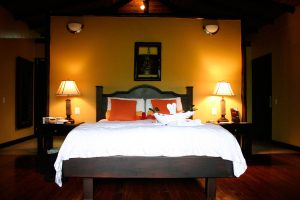
This bedroom has light switches at head height on both sides of the bed, and ample space around the bed for moving.10
Bedroom
Some modifications that can be made in the bedroom include:
- Ensuring there is enough space on both sides of the bed to wheel.
- Having a shorter bedframe or box spring to facilitate transfers from manual wheelchairs.
- Having hardwood or laminate flooring to maximize wheeling in the room, although a low pile carpet may be okay as well.
Placing a second, lower bar in the closet for easier reach.
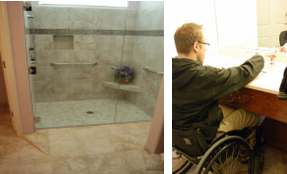
An adapted roll in shower with grab bars and a handheld shower head (left), and a sink with space to wheel under (right).11-12
Bathroom
Bathrooms are often the number one barrier in a home, specifically the shower. Some things to consider include the toilet height, the sink height, and the shower/tub. Some newer buildings use toilets with higher seats as they are easier for older adults to stand up, but this can make transferring an issue. Some modifications that can be made in the bathroom include:
- Using non-slip tiles.
- Installing a grab-bar for toilet or shower transfers.
- Having adjustable angles on mirrors.
- Installing roll in showers, with sides of the shower on a slight angle towards the drain.
- Using a handheld shower head, with connection to a rail for adjustable height.
- Placing wheel-in sink – sinks with space under them for a wheelchair to fit.
- Adding a raised toilet seat or a taller toilet for easier transfer.
Living room
Living rooms can be busy spaces filled wit#q2nh furniture and electronics such as televisions. Some modifications that can be made to make the living room more accessible include:
- Using arm chairs with a straight back and arm may provide support for rising and sitting.
- Obtaining an electric reclining chair, which can help for repositioning and is easy to operate.
- Ensuring there is enough space between furniture to maneuver.
- Using hardwood flooring throughout the main common rooms.
- Having low windows so you can see out of them.
- Having an open concept living room/dining room for easy moving.
- Using gas fireplaces for easy lighting.
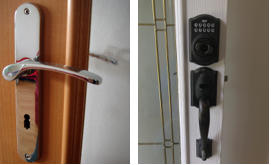
A lever-style door knob (left) and a lock key-pad (right) are some adaptations that can be used.13-14
Exterior
- Replace round doorknobs with lever door handles.
- Use a keyless entry/ use a code padlock in place of a traditional key.
- Use a folding ramp to go up a few stairs.
Other
- If building a ramp, ensure that the ramp is at least a 1:12 grade (i.e., for every one meter in elevation, the ramp should be 12 meters long).
- Create slip resistant surfaces with products such as non-slip strips, carpeting, or sand paint.