
What are urinary tract infections?
Author: SCIRE Community Team | Reviewer: Bonnie Nybo | Published: 9 November 2018 | Updated: ~ Nov 9, 2018
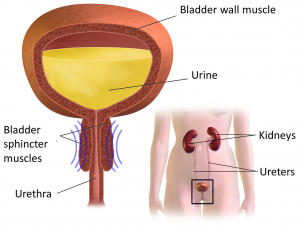
Urinary tract infections can happen in the kidneys, bladder, or their connecting tubes.1
A urinary tract infection (commonly called a ‘UTI’) is an infection of part of the urinary tract. This may be the kidneys, the bladder, or the urinary tract’s connecting tubes (the ureters or urethra). Kidney infections are called pyelonephritis and bladder infections are called cystitis.
Urinary tract infections are common after SCI, affecting around 1 in 5 people early after injury, and as many as 7 in 10 people living with SCI long-term.
In severe cases, UTIs can progress to a life-threatening infection called sepsis. In the early days of SCI care, complications of UTIs were the most common cause of death after SCI.
Today, treatment and prevention of UTIs is much more effective and infections can be treated effectively in most cases. However, it is very important to take steps to prevent infections and to seek out treatment for new infections as soon as they are detected.