
What is the spinal cord?
Author: SCIRE Community Team | Reviewer: Riley Louie | Published: 21 September 2017 | Updated: ~
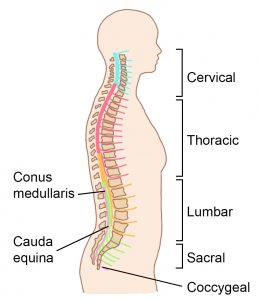
The spinal cord is divided into 31 segments, which each give rise to a pair of spinal nerves.3
The spinal cord is a long bundle of nerve tissue that is located in the spine. It is the main pathway for nerve signals travelling between the brain and the rest of the body. It is also the centre for the body’s reflexes.
The spinal cord is made up of millions of microscopic nerve cells. Protective layers of tissue called meninges cover the spinal cord and a special fluid called cerebrospinal fluid cushions the spinal cord within the spine.
The path of the spinal cord
The spinal cord begins at the base of the skull, where it connects to the brain through the brainstem. The spinal cord then runs down through the spine’s hollow central spinal canal.
The spinal cord is shorter than the spine, so it does not travel the full length of the spine. It ends at a point called the conus medullaris near the first or second lumbar vertebra. From this point down, spinal nerves branching from the end of the spinal cord sit within the spinal canal in a bundle called the cauda equina.
Spinal cord segments

Spinal nerves extending from the spine.4
The spinal cord is divided into 31 nerve segments from top to bottom:
• 8 cervical segments
• 12 thoracic segments
• 5 lumbar segments
• 5 sacral segments
• 1 coccygeal segment
Each segment is a part of the spinal cord that gives rise to a pair of spinal nerves (one right and one left). The spinal nerves exit the spine through archways between the bones and continue outward to become the nerves of the arms, legs, and body.