
What causes non-traumatic SCI?
Author: Dominik Zbogar, Kelsey Zhao | Reviewer: Peter New | Published: 17 September 2024 | Updated: ~
Causes of NTSCI can be divided into three major categories: congenital, genetic, and most commonly – acquired.
Congenital (present at birth)
Congenital NTSCIs are developmental defects, malformations, and abnormalities affecting the spinal cord which are present at birth. An infant can have one congenital condition, or multiple conditions at the same time. For example, Type 2 Chiari malformations almost always occurs in association with myelomeningocele, a severe form of spina bifida
Spinal dysraphism
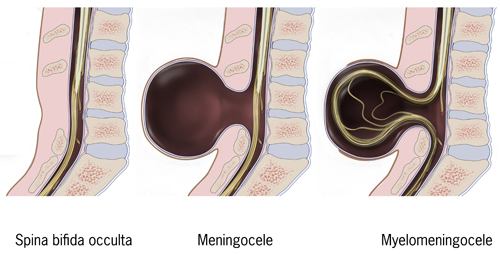
Myelomeningocele is the most severe type of spina bifida as the spinal cord itself protrudes through the opening of the unfused portion of the spinal column.2
Spinal dysraphism is a defect in the development of the neural tube (an early form of the brain and spine) where the canal that houses the spinal cord does not completely close and causes damage to the spinal cord and nerves. A well know type of spinal dysraphism is spina bifida.
Chiari malformations
Chiari malformations are a condition where a part of the brain known as the cerebellum is pushed into the space where the brain connects to the spinal cord.
Skeletal malformations
Skeletal malformations include any deformities or abnormalities in the development of bones or ligaments that affects the spine. These malformations can put the person at higher risk of spine instability which can cause pressure on the spinal cord that can result in NTSCI.
Congenital syringomyelia
Congenital syringomyelia is the formation of a fluid-filled sac, known as a cyst or syrinx, in the spinal cord. This often occurs in association with spina bifida or Chiari malformations, but can also happen on its own, spontaneously.
Genetic
A genetic NTSCI comes from an abnormality in a person’s genes that affects the spinal cord. This abnormaility can be inherited from one’s parents or be a spontaneous mutation that occurred during development. The effects of this genetic abnormality can be present at birth or show up later in life. Most genetic NTSCIs lead to loss of movement and/or sensation from the degeneration of nerve cells.
Some examples of genetic NTSCI types include hereditary spastic paraplegia, spinocerebellar ataxias (e.g. Freidrich’s ataxia), adrenomyeloneuropathies, leukodystrophies, and spinal muscular atrophy.
Acquired
Acquired conditions include the most common causes of NTSCI, such as degenerative spinal cord conditions, tumours, and vascular problems. This is a diverse category and the conditions become more common in older age.
Degenerative
Degenerative NTSCIs include any condition that causes damage to the spinal cord through the degeneration of its bone or ligaments. For example, spondylosis is a condition where there is an abnormal and painful degeneration in the bones and cartilage of the neck that can lead to loss of control or sensation over parts of the body.
Metabolic
Metabolism is the processes in the body that turns food into energy and the components that make up and maintain the body. Nutrient deficiencies like vitamin B12 and folate deficiency, or diseases that affect the maintenance of bone like osteoporosis and Piaget’s disease, can cause degeneration or damage to the spinal cord.
Vascular
Vascular causes of NTSCI refer to spinal cord damage caused by problems with the vessels that carry blood through the body. For example, if a blood vessel bursts and bleeds, if there are issues with abnormal connections between vessels, or if the blood supply is blocked, the spinal cord could be damaged. These issues can happen anywhere in the body and can cause NTSCI when they happen in the spinal cord.
Inflammatory or auto-immune
Inflammatory and auto-immune conditions involve immune system activity that damages the spinal cord through swelling (inflammation) or direct attack on healthy cells (auto-immune). The immune system is normally responsible for protecting us from viruses, bacteria, and other orgamisms but different conditions can cause overactive or innapropriate immune reactions. Examples include transverse myelitis and multiple sclerosis.
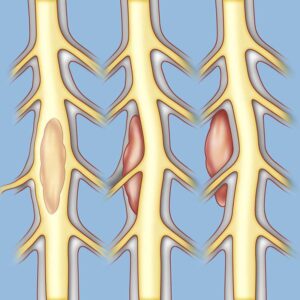
Spinal tumors may be (left to right) intramedullary, intradural-extramedullary, or extradural.5
Tumors and masses
Benign or malignant tumours can cause a NTSCI if the growth of the mass puts pressure on the spinal cord or interferes with the blood supply.
Infection
The spinal cord can be infected by bacteria, viruses or other organisms. Infections can put pressure on the spinal cord due to an abcess (pocket of infection) or interfere with the blood supply.
Other
Other uncommon causes of NTSCI include damage to the spinal cord due to radiation exposure and exposure to toxic substances. Amyotrophic lateral sclerosis and primary lateral sclerosis are both rare degenerative diseases that affect the motor neurons which are the nerve cells involved in the control and coordination of movement.
Are Multiple Sclerosis and ALS types of NTSCI?Multiple sclerosis (MS) is an auto-immune disease where the immune system attacks the protective covering (myelin) of nerve fibers in the central nervous system, which is made up of the brain and spinal cord. Amyotrophic lateral sclerosis (ALS) is a progressive nervous system disease that affects nerve cells in the brain and spinal cord. Because lesions can occur not only in the spinal cord but in the brain too, categorizing them is a challenge. Some studies include MS and ALS with their SCI sample while others choose to exclude these conditions. |