
What are “upper” and “lower” motor neuron injuries?
Author: SCIRE Community Team | Reviewers: Shannon Sproule , Tova Plashkes , Amrit Dhaliwal | Published: 17 February 2017 | Updated: 26 March 2024
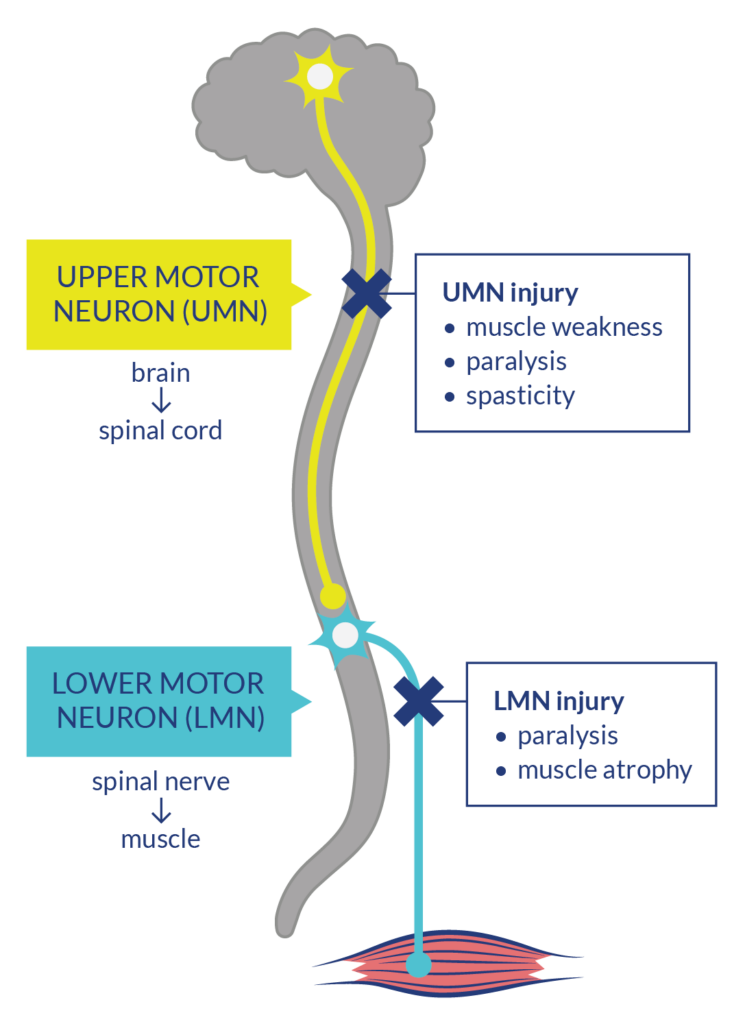
Nerve pathways that send movement commands from the brain to the muscles are made up of two types of neurons:
upper motor neurons
(UMNs) which start in the brain and go down the spinal cord, and
lower motor neurons
(LMNs) which connect to the UMN in the spinal and go out to the muscles.
UMN injuries disrupt the neuron connection from the brain to the muscles but keep the spinal reflexes of the LMNs (automatic movement responses to pain or sensation that don’t require signals from the brain), intact. The disruption of brain commands causes muscle weakness/paralysis and leaves the spinal reflexes unmoderated, which presents as spasticity. The uncontrolled activity of spinal reflexes also maintains muscle tone. In contrast, LMN injuries disrupt the neuron connection from both the brain and spinal cord to the muscles. There are no signals going to the muscles at all, which causes muscle paralysis and atrophy (degeneration).
Refer to our article on Spinal Cord Anatomy for more information on motor neurons and spinal reflexes!
The effects of UMN and LMN injuries in SCI can be seen in various systems of the body.
Effects of UMN injury in SCI:
- Spastic neurogenic bladder and/or bowel
- Sexual health – loss of psychogenic arousal (from thoughts) but retain reflex arousal (from touch)
- Spasticity
- Autonomic Dysreflexia
Effects of LMN injury in SCI:
- Flaccid neurogenic bladder and/or bowel
- Sexual health – loss of reflex arousal but retain psychogenic arousal
Refer to our articles on Bladder Changes After SCI, Bowel Changes After SCI, Sexual Health After SCI, Spasticity, and Autonomic Dysreflexia for more information!
Mixed UMN and LMN injuries
Depending on their injury, a person with SCI could be more likely to have UMN, LMN, or both injuries at the same time. For example, a cauda equina injury happens at the bottom of the spinal cord where all the nerves are LMNs, while a conus medullaris injury is likely to be a mix of both. Injuries caused by trauma will often injure both the UMNs at the spinal cord and surrounding LMNs.
Relevance to treatment
The advancement of treatments like nerve transfer and functional electrical stimulation that depend on intact LMN function bring attention to the need to distinguish UMN from LMN injury. Determining if one has an UMN or LMN injury is accomplished by diagnostic techniques such as nerve conduction studies and electromyography.
Refer to our articles on Nerve Transfer Surgery and Functional Electrical Stimulation for more information!