
What is the International Standards for Neurological Classification of Spinal Cord Injury exam?
Author: SCIRE Community Team | Reviewers: Shannon Sproule , Tova Plashkes , Amrit Dhaliwal | Published: 17 February 2017 | Updated: 26 March 2024
The International Standards for Neurological Classification of Spinal Cord Injury (ISNCSCI) exam (often called the American Spinal Injury Association (ASIA) exam) is a physical exam that is used to classify spinal cord injuries. It determines both the neurological level of injury and the completeness of the injury.
During this exam, a health provider such as a doctor or physiotherapist will carefully test for sensation and strength at specific points on the body and use the exam findings to determine the characteristics of the injury. These tests include:
- Testing for “light touch” sensation (if you can feel the touch of a cotton swab or tissue and whether it feels normal)
- Testing for “pin prick” sensation (if you can feel whether the touch of a safety pin is sharp or dull and whether it feels normal)
- Testing for muscle strength of specific muscles (if you can resist against certain movements applied by the health provider)
- Testing for movement and sensation of the anus. This is a very important test because it is the only way we can determine if a person’s injury is complete or incomplete). It is testing the last nerves to leave the spinal cord (S4 and S5).
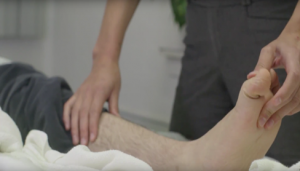
Testing muscle strength as part of the ISCNSCI Exam.10
ASIA Impairment Scale (AIS)
The ASIA Impairment Scale (AIS) describes the completeness of the injury. This scale identifies whether a person has any movement or sensation in the lowest levels of the spinal cord (S4 and 5) and what movement or sensation they have below the neurological level of injury. If you are interested in learning how healthcare providers are trained to do the test, you can visit: scireproject.com/outcome/ais/.
| A, Complete | No sensation or movement below the injury, including around the anus (S4 and 5) |
| B, Sensory Incomplete | There is sensation, but not movement below the injury, including around the anus (S4 and 5) |
| C, Motor Incomplete | There is movement, but not sensation below the level of injury and more than half of the muscles below the injury are quite weak |
| D, Motor Incomplete | Movement is present below the injury and at least half of muscles below the injury have close to normal strength |
| E, Normal | Sensation and movement are normal |