
What are “complete” and “incomplete” spinal cord injuries?
Author: SCIRE Community Team | Reviewers: Shannon Sproule , Tova Plashkes , Amrit Dhaliwal | Published: 17 February 2017 | Updated: 26 March 2024
Complete spinal cord injury
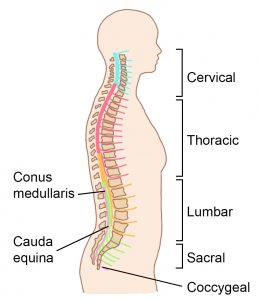
The spinal cord, conus medullaris, and cauda equina.7
A complete spinal cord injury is when there is a total loss of strength and sensation below the spinal cord injury. This must include complete loss of movement or sensation of the anus (S4 and S5).
In some cases, people with complete injuries may still have some areas of strength or sensation below level of injury (but not including S4 and S5). These areas are known as zones of partial preservation.
Incomplete spinal cord injury
An incomplete spinal cord injury is when some strength and/or sensation remain below the spinal cord injury. This must include some movement or sensation of the anus (S4 and S5).
Incomplete injuries can have very different symptoms depending how much and in what way the injury has affected the spinal cord. These have traditionally been described as different “syndromes”, but more often now are best described by the characteristics of the person’s unique symptoms.
You may hear your healthcare providers use these terms:
| Syndrome | Area of spinal cord injury | Key Symptoms |
| Central cord syndrome | Central areas of the cervical spinal cord |
|
| Brown-Séquard syndrome | One half of the spinal cord (the right or left side) |
|
| Conus medullaris syndrome | The end of the main part of the spinal cord and the start of the ’cauda equina’ |
|
| Cauda equina syndrome | The nerves in lowest part of the spinal canal once the “true” spinal cord has ended |
|