
How can a cushion help redistribute pressure?
Author: Sharon Jang | Reviewer: Emma M. Smith | Published: 25 May 2020 | Updated: ~
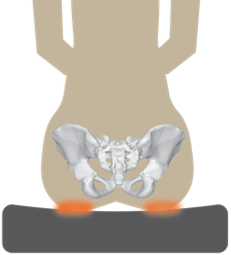
When sitting, pressures are created (orange) from the force of your sit bones on your buttock.2
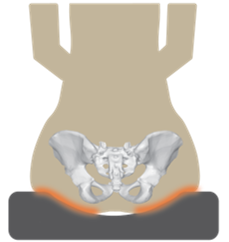
During offloading, a greater surface area of the buttock is in touch with the cushion.3
Pressure sores develop when there is a lot of pressure applied at one point. We can counter this focussed pressure through pressure redistribution, i.e. spreading out the sitting pressures. This can be done in three ways: offloading, immersion, and immersion and envelopment.
When offloading, pressure is distributed over a greater surface area. To achieve this, pressure is distributed over the majority of the buttock (i.e., more of the buttock is in contact with the cushion) rather than just on the sit bones (see top right image). To encourage this position, a piece of the cushion may be taken out so there is a grooved surface.
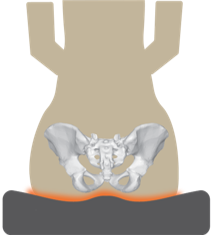
Immersion and envelopment is a combination of sinking into the cushion and having the cushion form to the shape of your buttock.5
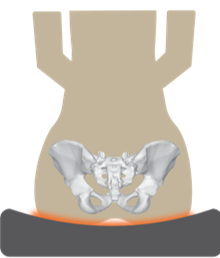
During immersion, the buttock sinks into the cushion.4
Immersion refers to a property of the cushion material, which allows the body to “sink” into it. Given the material’s ability to be compressed, pressure is redistributed by increasing the amount of body surface area that is in contact with the cushion.
Immersion and envelopment redistributes pressure by allowing the body to sink into the material, while the material conforms to the body’s shape. This maximizes pressure distribution by increasing the amount of surface area in contact with the cushion.