
What aspects of a backrests can be modified?
Author: Sharon Jang | Reviewer: Emma M. Smith | Published: 25 May 2020 | Updated: ~
The main purposes of backrests are to provide stability and support to the trunk and the hips. Backrests are adjustable in three different ways: the height, the shape, and the stiffness.
Height
For manual wheelchair users, the height of the backrest can vary. Low backrests provide support for the lower back, and are often preferred by active users as they allow for more mobility in the upper spine. However, the use of a low backrest requires complete or partial trunk control, as it does not provide much stability. Higher backrests typically span the majority of the back, but should come up to just under the shoulder blades. A higher back rest can provide more support, but a backrest that is too high may hinder mobility.
There has been some research on the impact of various backrest heights on the range of motion required for propulsion and reaching/grasping motions. One study (weak evidence) has shown that the height of the backrest may influence the efficiency of pushing a manual wheelchair. In particular, the authors suggest that a low back rest may be more beneficial for wheelchair propulsion, as it allows for greater movement in the shoulder, a greater push rate (i.e., more pushes per minute), and a greater propulsion stroke. In addition, a lower back rest has been found to allow paraplegics to apply more force when propelling their wheelchairs. However, with regards to reaching, a (weak evidence) study found that backrest height did not have an effect.
As power wheelchair users do not need to manually propel their wheelchair, the height of the backrest is typically higher. These backrests typically span the entire length of the back, and provide more support to the spine. Moreover, having a taller backrest can provide a resting position for tilt or recline functions.
Shape
Backrests generally come in three different shapes: flat, general contour, and custom contoured.
Flat backrests
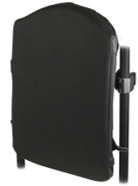
Flat backrests are flat or slightly curved in shape, and often consist of a stiff flat surface (e.g., plastic, plywood) that is layered with foam and covered with material. This style of back allows for the greatest range of motion of the arms, thus creating increased freedom. Another advantage of the flat backrest is that it is very adjustable and can accommodate a large variety of support accessories, such as lateral supports, chest straps, and headrests. A drawback to this style of back is that it provides limited support. It does not accommodate for the shape of the spine, making it less suitable for individuals with
lordosis
(i.e., sway back) or
kyphosis
(i.e., a hunched back).
General contoured backrests
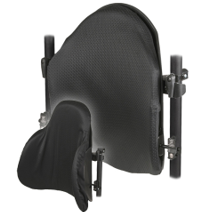
General contoured backrests are off-the-shelf backs that are shaped, but are not customized to your back. These backs provide more support than a flat back, as they have a deeper contour that can provide lateral (side) support. The effectiveness of general contoured backs is based on how well the back fits your needs; they may only be effective if you can find one that suits your needs.
Custom contoured backs
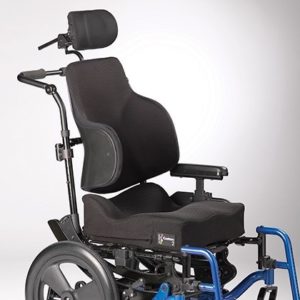
Custom contoured backs provide increased support for positioning, and are made custom to the shape of your back. This cushion is often used if you require extra positioning support, and if the general control back or flat back does not meet your needs. The creation of custom contour backs can be a lengthy and costly labour-intensive process. When creating a custom contour back, a mold of your back is taken. A seating specialist then inspects the mold to ensure that it is reflective of the shape of your back and that the contour information is accurate. The backrest is then carefully made to the specifications obtained from the measuring process. As custom contour backs are designed to fit the shape of your back to provide more support, they also impose limitations on flexibility. When transferring in and out of your wheelchair, it is also important to be properly aligned in your custom contoured backrest, as improper fitting may lead to pressure sores or skin breakdown.
Stiffness
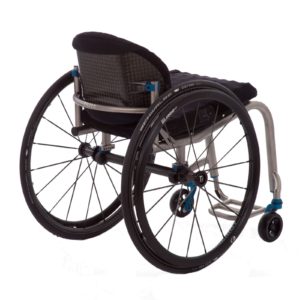
A rigid back on a manual wheelchair.13
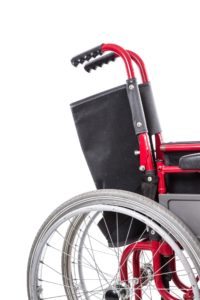
Soft backs are often found on folding manual wheelchairs.14
The stiffness of wheelchair backs are either soft or rigid. Soft backs (i.e., sling backs) are able to accommodate to the shape of the spine and can be effective if they are properly adjusted. However, they provide less support compared to rigid backs and can stretch over time depending on the fabric. Tension adjustable backs consist of interwoven straps that can be tightened or loosened to accommodate for posture. One weak study found that the use of a tension adjustable back provides more support than a normal sling back. While it provides more support for the hips, it may still result in poor posture. Rigid backs generally provide more support and can help with stability. However, rigid backs are less adjustable, and do not accommodate for the shape of the spine. Although rigid backs may be more supportive, weak evidence has suggested that rigid backs are less comfortable than sling backs among individuals with tetraplegia.