
How is inspiratory muscle training done?
Author: SCIRE Community Team | Reviewer: Shannon Sproule | Published: 21 November 2017 | Updated: ~
Speak with a health provider before using inspiratory muscle training to make sure it is safe and suitable for you and to learn how to use the equipment correctly.
Inspiratory muscle training is done using a device that makes breathing in more challenging. The device has some type of mechanism that creates resistance when the person breathes in, but allows breathing out to occur freely. There are several different types of inspiratory muscle training devices:
- Resistive trainers are the simplest trainers. They have a range of small diameter holes, which the person breathes in through. The smaller the hole, the greater the challenge is. The drawback of these trainers is that the resistance changes if you breathe in quickly or slowly.
- Threshold trainers have a spring-loaded valve that provides resistance. The valve can be adjusted for difficulty level. These trainers provide the same resistance if you breathe in quickly or slowly.
- Isocapneic hyperpnea involves a more complex device that allows breathing to be done at lower levels of resistance and higher flow rates. This device uses a rebreathing bag that helps maintain carbon dioxide levels in a normal range. This device uses targets to increase the intensity of breathing to a training level.
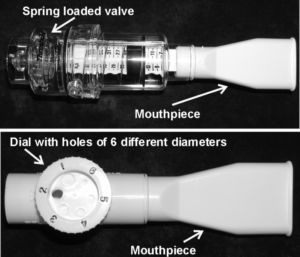
Different types of inspiratory muscle trainers – Top: threshold trainer; bottom: resistive trainer.2
Your health provider will assist you with selecting an appropriate trainer and supervise your early training. The device is held to the mouth with a clip over the nose. Some people with reduced hand movement will need someone to position and hold the trainer during each training session. Alternatively, tilting the chair backwards or using a stand to hold the trainer may assist with positioning the mouthpiece independently.
Inspiratory muscle training involves regular sessions of breathing exercises consisting of a set number of breaths and sets. Sessions often last around 30 minutes and are done 2 to 3 times per day. However, the ideal protocol for inspiratory muscle training for people with SCI is not yet known.
Inspiratory muscle training is usually done for at least 6 weeks to allow enough time for the muscles to become stronger and adapt to training. Like other exercise, training should be continued regularly for strength to be maintained.