
What is osteoporosis?
Author: SCIRE Community Team | Reviewer: B. Catharine Craven | Published: 11 October 2017 | Updated: 14 March 2019
Osteoporosis is a condition in which the bones become less dense, changing the bone structure and making the bones more likely to break.
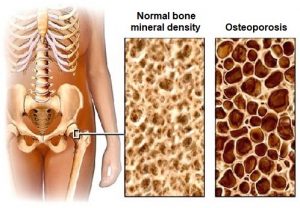
Bone mineral density is low in osteoporosis, making bones porous and brittle.1
A bone mineral density test helps you and your doctor to measure the density of your bones and estimate how likely you are to get a fracture (broken bone) in the next ten years. Centres with expertise in SCI will ask you to have the density measured of your spine, hip and knee regions.
Healthy bone is constantly being broken down and reformed by the body’s cells in a process called bone remodeling. As a part of this process, the cells that breakdown bone tissue and the cells that create new bone, work to keep or increase the bone’s strength. Bones can adapt and change to the demands placed on them
After SCI, the cells that breakdown bone (osteoclasts) work over time, and the cells which build bone (osteoblasts) cannot keep pace, this results in thinning of the bone cortex and a lower number of bone cross struts and trabeculae. These changes in the bone decrease bone mineral density, usually areas rich in trabelcular bone are affected first and then the bone cortex.