
What is osteoporosis after SCI?
Author: SCIRE Community Team | Reviewer: B. Catharine Craven | Published: 11 October 2017 | Updated: 14 March 2019
Osteoporosis often affects people with SCI in a unique pattern called sublesional osteoporosis (‘sublesional’ means ‘below the level of injury’). Sublesional osteoporosis is a condition which involves:
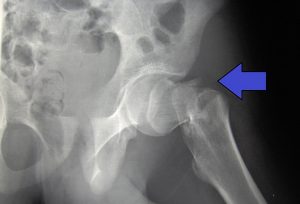
X-ray image of a hip fracture.2
Excessive bone resorption below the level of injury
Low bone mineral density of the hip and or knee regions
An increased risk of fracture
Bone tissues start to breakdown as early as the first few days after SCI. Among people with motor complete SCI, bone tissue resorption is highest between 3 and 6 months after injury and may continue for years. The rate of decline in bone density is less predictable in people with incomplete or non-traumatic SCI.
Osteoporosis is very common in people living with SCI long-term and increases the risk for fragility fractures.
Fragility fractures
Fragility fractures are fractures caused by minimal force such as twisting during a transfer or a low speed fall from your wheelchair.
Fragility fractures typically happen at the lower part of the femur (thigh bone) just above the knee and the top of the tibia (shin bone) just below the knee. A red or swollen leg should prompt you to have an x-ray to rule out a fracture. Fractures can cause serious medical problems such as blood clots, skin infections, and pressure sores. Fractures above the knee are usually fixed by a surgeon, whereas fractures below the knee are usually casted. After SCI, fractures can be slow or hard to heal.