
How are urinary tract infections diagnosed?
Author: SCIRE Community Team | Reviewer: Bonnie Nybo | Published: 9 November 2018 | Updated: ~ Nov 9, 2018
Medical examination
Your doctor will ask you about your medical history and symptoms and perform a visual and physical inspection. If they suspect that you might have a UTI, they will likely take a urine sample and do additional testing, such as a dipstick test and urine culture. Since most people with SCI will have a positive dipstick test or urine culture, the inspection of the urine, physical examination and history is very important to assist with directing treatment.
Urine sample
Taking a urine sample can help to confirm whether there is a UTI. The sample is then tested for signs of infection, bacteria and other features.
Taking a good urine sample
Urine for a urine sample needs to be collected in a careful way to ensure that it provides accurate information. To take a good urine sample, the genital area should be washed first. Urine is collected in a sterile container midstream during urination or catheterization. If the sample is collected from an indwelling catheter, the catheter should be changed first. Samples are never taken from a urine drainage bag. These steps can help to prevent the sample from being contaminated.
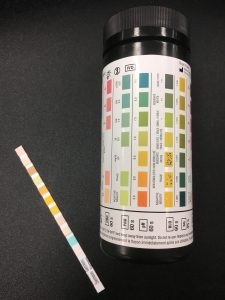
The dipstick or urine test strip is a basic diagnostic tool for identifying presence of substances or infection in urine.3
Dipstick Test
A dipstick test is a standard urine test strip that provides results in minutes. A positive result for leukocytes and nitrites indicates the need for a urine culture. Antibiotics would not be prescribed based on this test alone.
Urine culture
A urine culture may be done to determine the amount and type of bacteria causing the infection. This test is done using a urine sample that is left in conditions where bacteria can grow if they are present. It can later be tested to determine what type of bacteria are present, and a suitable antibiotic for treatment.
Imaging
Various imaging tools can be used to visualize the urinary tract and detect structural abnormalities. Some examples are ultrasound or magnetic resonance imaging (MRI). A cystoscopy is a more invasive way to view the urinary tract in greater detail. It involves inserting a long thin camera through the urethra and up into the bladder.
Bacteria in the urine alone does not require treatment
Although the bacteria in the urine can show a UTI, antibiotic treatment is not recommended unless it is also accompanied by other symptoms. People who use catheters often have some bacteria in the urinary tract, which does not indicate an infection. This is important because frequent use of antibiotics when they are not necessary can create antibiotic resistance (where antibiotics become less effective).
However, people who are more vulnerable when they have an infection (such as pregnant women or young children) may still be treated in this situation.