
What types of catheterization are there?
Author: SCIRE Community Team | Reviewer: Bonnie Nybo | Published: 24 October 2017 | Updated: ~
There are several different types of catheters that may be used for bladder problems after SCI. The type of catheter chosen depends on the type of bladder dysfunction that you have (i.e. flaccid bladder or spastic bladder), as well as other factors like other health conditions, your self-care routines at home, level of independence, funding and lifestyle. It is important that you discuss your unique situation with your health providers to find the best treatment options for you.
Intermittent catheterization
The most common method of emptying the bladder after SCI is intermittent catheterization. Intermittent catheterization involves inserting and removing a catheter into the bladder through the urethra on a regular schedule during the day (usually every 4 to 6 hours) to drain urine from the bladder.

The timing of intermittent catheterization is important. Maintaining a regular schedule of bladder draining can help to prevent urine leakage and bladder overfilling. Your unique bladder schedule will depend on the type of bladder dysfunction you have and other factors like fluid intake.
Depending on the situation, intermittent catheterization may be performed by you, a caregiver, or a health provider. There are many different techniques that may be used to insert the catheter depending on level of hand function and whether you are a male or female.
However, it is very important for all individuals to maintain good hygiene each time intermittent catheterization is used, which includes washing your hands and genitals before inserting a new single use catheter and thoroughly cleaning and drying (moisture attracts bacteria) if reusing your catheters. If funding allows – reusing catheters is not recommended.
Indwelling catheters
Indwelling catheters (or Foley catheters) are tubes that are inserted directly into the bladder and remain in place to continually drain urine from the bladder.
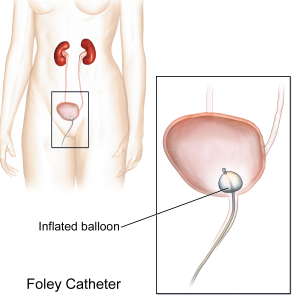
An indwelling (Foley) catheter is inserted through the urethra and held in place in the bladder by a small balloon.4
In most cases, indwelling catheters are inserted in through the urethra and into the bladder (known as urethral catheters). Once in the bladder, the very end of the catheter has a small balloon around it, which can be inflated to hold the catheter in place.
Indwelling catheters can also be inserted through a surgically created hole through the abdomen just above the public bone into the bladder called a stoma. These are called suprapubic catheters. Suprapubic catheters may be recommended as a later option for people who have medical complications or other reasons that make it difficult to use urethral catheters, such as intimacy.
Indwelling catheters may be used as a treatment option for people who are not able to insert a catheter regularly to perform intermittent catheterization, to allow for constant drainage of the bladder, and for people who have too much leaking of urine between uses of intermittent catheterization. Indwelling catheters are typically changed and replaced using sterile technique about once per month. Securement straps are recommended to secure indwelling catheter tubing as well as urine drainage bag tubing.
However, there are risks of having a catheter in the bladder all the time, such as increased risk of infections, sediment and bladder stones.
Condom catheters
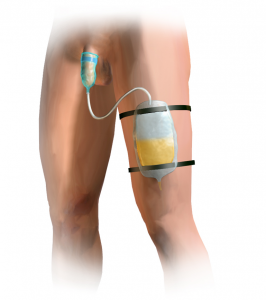
Condom catheter with drainage bag strapped to the thigh5
Condom catheters are catheters that are placed over the penis on males to collect urine. Condom catheters resemble a condom and are placed over the penis and connected through tubes to a collection device. Unlike indwelling catheters, condom catheters must be changed each day.
Condom catheters are usually used for people that either leak in between bladder emptying sessions or for individuals who have the ability to trigger emptying by causing a spasm of their bladder (called reflex voiding). Because they are used to collect urine as it passes out of the body rather than directly from the bladder, condom catheters are not usually used for people with difficulties causing the bladder to empty.
One of the main concerns of condom catheters is incomplete bladder drainage, which can cause kidney damage. Therefore, a careful medical examination is needed to ensure that use of condom catheters alone is an appropriate management technique. For people who can use them safely, condom catheters are often considered a safer long-term treatment option because they are less invasive than catheters that are inserted into the body.
Reflex voiding
Reflex voiding is a technique that can be used by some people with spastic bladder to cause urination. Reflex voiding is usually done by tapping over the bladder lightly and repeatedly with the fingertips or the side of the hand to stimulate reflex muscle contractions in the bladder that cause urination. This technique can be used to help improve bladder emptying during intermittent catheterization and when using condom catheters.
Older techniques for reflex voiding such as the Valsalva maneuver (increasing abdominal pressure by holding the breath and bracing) and the Crede technique (applying manual pressure onto the bladder through the abdomen) are NO longer used because they can cause too much pressure in the bladder, which can damage the kidneys.
Maintaining good hygiene
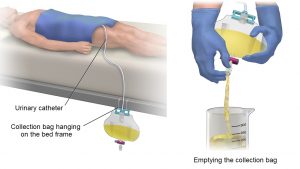
Catheter maintenance includes emptying and washing the collection bag regularly.6,7
Maintaining good hygiene and cleanliness is required when using all types of catheters. In addition to washing your hands and genitals before using catheters, it is important to clean the collection bag as well. The collection bag must be emptied once it is about ¾ full. This is essential to help prevent complications like infections and the weight of the bag causing the condom catheter to fall off or irritation to the urethra if using an indwelling catheter.
Although sterile technique (using medical grade techniques and equipment to reduce bacteria) may be used during catheterization, research suggests that clean technique (maintaining clean and hygienic, but not medical grade techniques) is sufficient to reduce risk of urinary tract infections.