
What emergency treatments are used after spinal cord injury?
Authors: SCIRE Community Team | Reviewer: Arlene Aspinall and Tova Plashkes | Published: 17 February 2017 | Updated: ~
Preventing movement of the spine
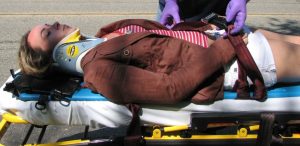
Individuals suspected of SCI are placed on a spinal board to immobilize their spine.9
If a spinal injury is suspected after an accident, the spine is stabilized to prevent movement. The whole spine will be stabilized regardless of where the injury is suspected to be. Emergency teams use special transfer techniques and equipment to maintain this stability during transport. Special equipment includes spinal boards, neck collars, blocks beside the head, and support straps.
Spinal trauma can happen in many different ways, and how a person is immobilized and removed from the accident scene must be suited to the situation. For example, emergency rescue techniques will be different if the person is in the water after a diving accident compared to someone who is in a car after an accident. Children and people with certain spinal conditions may be transported in slightly different positions because their spines have naturally different curves. The person is taken off of the spinal board as early as possible because staying too long on a spinal board can cause skin problems.
Supporting circulation

Low blood pressure and changes to heart rate can happen after an SCI. This can lead to poor circulation of blood in the body.
Intravenous
(
IV
)
fluids
(fluids that are given through a tube inserted into a vein) and medications are used to help maintain blood pressure and heart rate within a safe range.
Supporting breathing
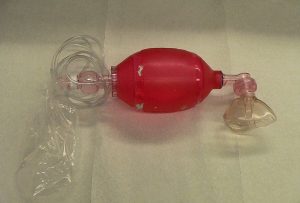
An inflated bag that connects with a facemask to give breaths.11
In emergency situations, emergency responders use an inflated bag that connects with a facemask to give breaths. Oxygen may be given through a facemask or nasal prongs. Some people need breathing tubes to support breathing, such as an endotracheal tube (a tube placed into the airway through the mouth) or a tracheostomy tube (a tube placed into the airway through an incision on the front of the neck). These tubes allow for more direct access for the breaths given from a mechanical ventilator or a healthcare provider.
Mechanical ventilation may be used if breathing problems continue in the hospital. Mechanical ventilation uses a machine to provide breaths or to assist with breathing. Some people may need to use mechanical ventilation permanently after injury, others for only a short time.
Tracheostomy
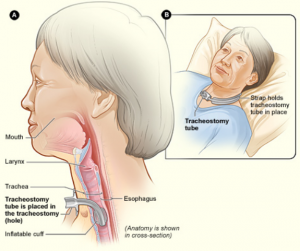
A tracheostomy is a hole between the front of the neck and the airway used for breathing.12
If mechanical ventilation is expected to continue for a long time, a tracheostomy may be needed. A tracheostomy is the creation of a hole from the outside of the front of the neck through to the trachea (windpipe) through which a tube is placed. Air can then bypass the mouth and nose; making mechanical ventilation more effective and allowing for tubes placed through the mouth to be removed. This can allow for better communication, eating, and mouth care. People who need a tracheostomy tube are often not able to speak or eat solid food right away as they need to relearn those skills as the muscles involved have become weak and uncoordinated.
Reducing pressure on the spinal cord and stabilizing the spine
In the days to weeks after an SCI first happens, pressure on the spinal cord from pieces of broken bone or other tissues can lead to further damage. This pressure can be removed through surgery or using non-surgical methods like traction. Traction is the use of a gradually applied force that pulls the vertebrae of the spine apart lengthwise (from the top of the head to the tailbone) to bring the spine into alignment. Traction can be applied using special equipment such as a halo brace or other methods. This technique is usually only used for certain types of cervical spine dislocations.
Spine surgery
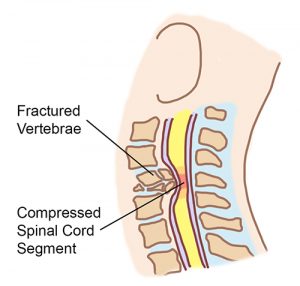
Removing pressure from pieces of broken bone or other tissues from the spinal cord is called ‘decompression.13
Spine surgery may be done to prevent further damage and allow for healing and early movement. Spine surgery may involve several procedures:
- Decompression is when anything that is putting pressure on the spinal cord, such as pieces of bone or other tissues, is removed.
- Reduction is the realignment of dislocated bones or pieces of bone into their proper positions.
- Stabilization or fusion may involve the use of surgical plates, rods, and screws, as well as bone grafts (a transplant of bone tissue from one area of the body to another) to keep the bones and bone pieces from moving while they heal and afterward.
After pressure is removed from the spinal cord, the spine may be stabilized to allow it to heal. This may be done surgically (see above) or non-surgically. Non-surgical stabilization may be done using rigid neck collars to stabilize the cervical spine and rigid or flexible braces for the thoracic and lumbar spine. Bracing is also sometimes used in combination with surgery and other treatments.
Preventing secondary injury (neuroprotection)
Damage to the spinal cord can continue for days to months after the injury because of processes like swelling and inflammation. This is called secondary injury. A number of treatments, such as methylprednisolone, have been suggested to help minimize secondary injury. These treatments are referred to as neuroprotection. Currently, there are no widely established treatments for this purpose. However, treatment options are available in some facilities and research activities in this area are ongoing.
Treating other injuries and illnesses
Injuries and illnesses other than the SCI may need treatment in the hospital. For example, brain injuries, bone and joint injuries, and severe bleeding often happen at the same time as an SCI and require additional treatments while in the hospital.
