Who is suitable for a nerve transfer?
Author: Kelsey Zhao | Reviewer: Michael Berger, Christopher Doherty | Published: 23 January 2024 | Updated: ~
Level of injury
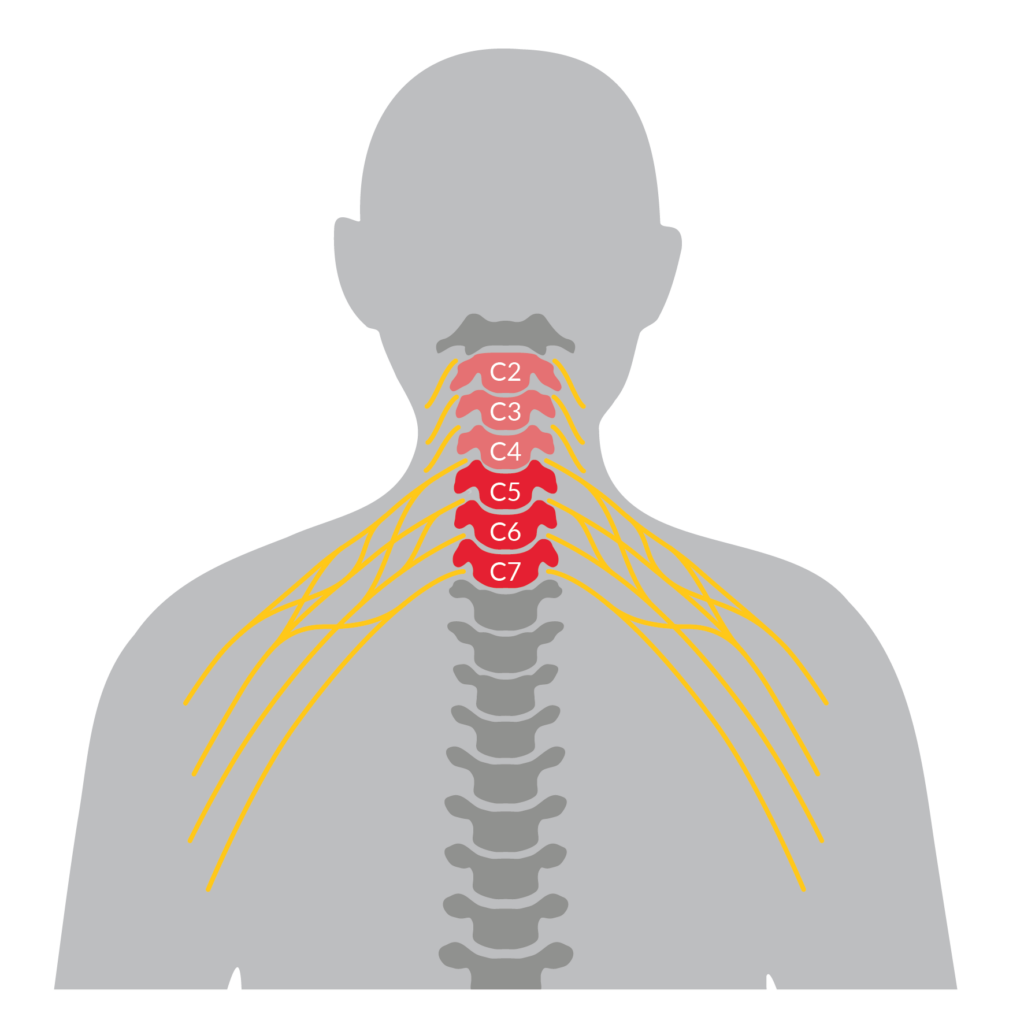
Nerve transfers are usually done on cervical spinal cord injuries levels C5-C7.7
Nerve transfers are typically used to improve arm and hand function for people with higher level spinal cord injuries between C5 and C7. Keep in mind that since nerve transfers are a surgical treatment targeting movement, suitability is based on the level of muscle function. For example, someone with an incomplete SCI whose overall level of injury is C3, but C5 for muscle function, is more likely to be eligible for nerve transfer than someone whose level of injury is C3 for both sensory and muscle function.
Recent studies have shown some success with nerve transfers in injury levels up to C2, but more recovery of movement is associated with lower levels of cervical injury. Consideration for nerve transfer surgery in levels above C5 is made on a case-by-case basis, depending on what donor nerves are available.
Refer to our articles on Spinal Cord Anatomy and Spinal Cord Injury Basics for more information!
Nerve function and time since injury
Two types of neurons make up the nerve pathways that send movement signals to and from the brain and the muscles.
- Upper motor neurons connect the brain to the spinal cord.
- Lower motor neurons connect the spinal cord to muscle.
The ideal timing for how long after SCI a nerve transfer can be performed depends on whether the upper or the lower motor neurons in the nerve pathway of the paralyzed muscle are damaged. Which motor neurons are damaged is different for nerve pathways that exit the spinal cord (out to the muscle) at the level of injury and nerve pathways that exit below the level of injury.
Motor neurons at the level of injury
Often, both lower and upper motor neurons are damaged at and around the level of injury. The loss of a functional nerve in the muscle causes it to degenerate and atrophy (waste away). The muscle atrophy becomes irreversible 12-18 months after the injury, at which point a nerve transfer would be unable to restore any movement to the muscle. In this case, a nerve transfer should be done around 6 months after SCI, so that the donor nerve cells can reach the paralyzed muscle before the degeneration becomes irreversible.
Motor neurons below the level of injury
Below the SCI, often the upper motor neuron is damaged but the lower motor neuron that connects the muscle to the spinal cord is still intact. The nerve in the muscle is still functional, but you cannot control it because the connection to the brain is disrupted. The muscle is maintained by the activity of the functional nerve’s connection to the spinal cord so degeneration occurs more slowly. In this case, a nerve transfer may be possible for years after the injury, but patient selection is more specific and surgery outcomes are less predictable.
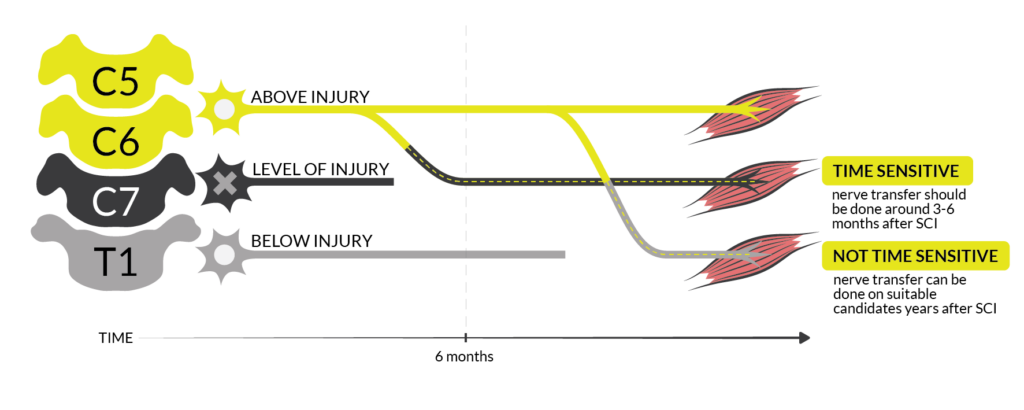
The timing of nerve transfer after spinal cord injury depends on whether the nerve that connects to the muscle is damaged. If it is, the muscle will degenerate more quickly, and nerve transfer should be considered earlier.8
Other considerations
Some other factors to consider when deciding whether to do a nerve transfer surgery include:
- Caregiver availability for the period after surgery when you will need extra support with daily activities.
- Emotional/psychological supports.
- Personal goals for function or recovery. Speak to your health care provider to determine whether a nerve transfer is suitable for your goals.
- Transportation to the clinic or hospital for diagnostic testing, the surgery, and rehabilitation.
- Other injuries in the arms, hands, or wrists or other neurological conditions that could increase the risk of complications in surgery and/or rehabilitation.
- General considerations for surgery (e.g., open wounds, infection, high blood pressure, diabetes, heart and lung problems, extreme obesity, mental health).
- SCI considerations for surgery (e.g., pressure sores, joint stiffness, spasticity, autonomic dysreflexia).