How does acupuncture work?
Author: SCIRE Community Team | Reviewer: Amrit Dhaliwal | Published: 5 July 2019 | Updated: ~
Traditional Chinese medicine explanation
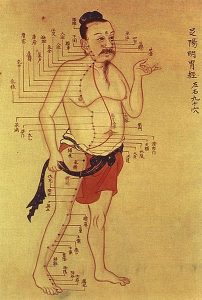
Ancient illustration of the acupuncture meridians based on Traditional Chinese Medicine.3
Traditional Chinese medicine (TCM) is based on the belief that illness happens because of imbalances in energy flow in the body. This energy flow is known as Qi (pronounced ‘chee’) and is thought to flow along lines of energy in the body called meridians. Traditional acupuncture points are located where these lines are believed to pass close to the surface of the skin. Thus, stimulating acupuncture points with needles is thought to promote balance of the body’s energy and treat health conditions.
Modern explanations
Traditional explanations for how acupuncture works do not align well with modern science. Scientists are not entirely sure how acupuncture might work, but its effects are likely related to influences on the nervous system and/or circulation.
Pain
Scientists have proposed several possible explanations for how acupuncture could work to reduce pain:
- By blocking pain from traveling in the nerves
- By causing the body to release substances that prevent pain (such as endorphins)
- By altering blood circulation in important areas of the body
Bladder problems
Acupuncture may affect bladder function by influencing nerve signals or control centers for urination in the brain and spinal cord.
Functional recovery
Acupuncture has been proposed as a treatment to improve recovery of function after SCI. This is not well understood, but some scientists have proposed that it may be related to reducing damage caused by the after-effects of the injury.