What maintenance should be done for a power wheelchair?
Author: Sharon Jang | Reviewer: Ian Denison | Published: 3 January 2025 | Updated: ~
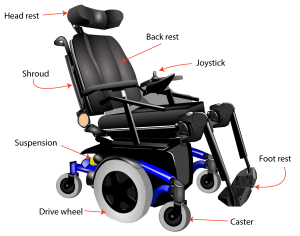
Maintaining a power wheelchair may seem intimidating given the integration of electronics, but most activities are fairly simple. Below we discuss the tasks you should complete with your wheelchair.
Daily
Battery
Properly charging your battery is important in maintaining its health. Do not charge the battery too frequently with little use, or let your battery completely die. If you are using your wheelchair every day, charge your batteries every night. Batteries should be charged for 8-12 hours, even though the charging lamp has gone off.
Plastic shrouds

Shrouds are the plastic coverings that protect the electronics and the battery of the wheelchair from dirt and moisture. To check them, make sure that they are present and intact. Try to jiggle the shrouds around to ensure they are not loose.
Brakes
The brakes are essential to safe use of your wheelchair. On a power wheelchair, the brakes are connected to the motor. When you drive, they automatically disengage, and when you stop, they automatically re-engage with an audible clicking sound. If you suspect something wrong with your brakes, try the following:

Turn down the speed of your wheelchair
Push the joystick forward and then stop. Upon stopping, you should hear a clicking sound. This indicates that your brakes are working.
Weekly
Tire inflation, Cushion inspection
Similar to manual wheelchairs, pneumatic tires and cushions should be inspected on a weekly basis to optimize their performance. Refer to the tire inflation and cushion inspection instructions in the manual wheelchair maintenance section above.
Motor
The motor is an integral part of the wheelchair, as its job is to convert power from the battery into energy to move the chair. It is normal for the motor to make some noise when it is being used. Try to become accustomed to what your motor sounds like so you are able to detect any changes. Over time, it is normal for the motor to become a bit louder; however, excessive noise may be indicative of an issue. If you notice any sounds that you are unable to recognize, contact your wheelchair provider.
Controller and joystick
The controller of a wheelchair often consists of a power button, a screen, and a joystick. It is the interface used to control the driving, speed, and positioning of your wheelchair. Before inspecting your controller, make sure that it is switched off. There are two main aspects of inspecting the controller:
-
- Check the joystick and the rubber connection between the joystick and the control for any cracks or wear. This protective covering acts to keep dust, dirt, and moisture out of the electronics. And so damage to the covering may eventually lead to failure of the control.
- Check the wiring of the joystick. Ensure that none of the connecting cables are frayed or showing through the insulation.
Monthly
Cushion, cushion cover, and foot plates.
Cushions, cushion covers, and footplates should be maintained and inspected at least once a month. The maintenance and checking process for these items are similar to manual wheelchairs. For more information, refer to the section “What maintenance and checks should I do for my manual wheelchair?” above.
Tire
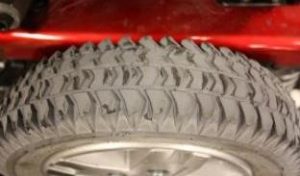
The treads on your tire play a key role in maintaining traction and maintaining the stability and maneuverability of the wheelchair. Some tires may have less tread than others; note how much tread your tire starts off with. Check the tire treads monthly to ensure that they are not worn.
Caster
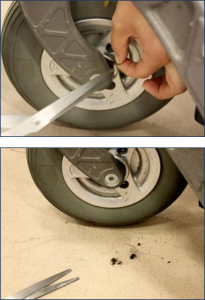
The axles of the front caster wheels of the wheelchair are the lowest to the ground, and thus are susceptible to picking up hair, dust, lint, and dirt. Buildup on your axles can lead to premature wearing and increased rolling resistance. For example, hair wrapped around the caster wheel can lead to breakage. Using a pair of scissors, tweezers, a toothbrush, or pliers, remove debris from the caster.
Frame
Inspect the frame and weld points on the wheelchair and ensure there are no cracks. Make sure all fasteners are appropriately tight.
Backrest
The backrest of your wheelchair is important for support and your posture. Maintaining the backrest of a power wheelchair is similar to a manual wheelchair. Refer to the manual wheelchair section for further details.
Wiring and electronics
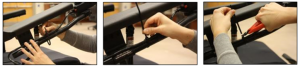
There are many wires throughout a powered wheelchair that are essential to making the wheelchair move. To safeguard the use of your wheelchair, make sure that all of the wires are in place and free from dirt and corrosion. If you notice any exposed wires or corrosion on the wires, take it to a dealer. If wires are hanging out or are in the way of your day-to-day use, it may be beneficial to connect the wires to a support (e.g., armrest, frame, etc) as shown below.