
What are the benefits of using a propulsion assist device?
Author: Sharon Jang | Reviewer: Jaimie Borisoff | Published: 15 May 2020 | Updated: ~
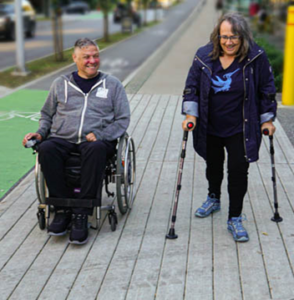
Using a propulsion assist device can be beneficial to manual wheelchair users. The man on the left is using a powered add-on.2
Power assist devices may be purchased by individuals with or without a prescription. Some indications for propulsion assist device use are limited strength in the upper body, or for those that are at a higher risk of an injury or pain to the arms and/or shoulders. These devices may improve participation in the community by enabling increased travel distance and access to more difficult environments.
In two studies (weak evidence), users of propulsion assist devices have reported benefits including:
- Less strain on the cardiovascular and respiratory systems; this results in reduced overall feelings of fatigue.
- Being able to go further with less effort (improved propulsion efficiency). This may help prevent overuse injuries.
- Increased distance you are able to travel before feeling tired.
- Travelling up and down hills.
- Improved ability to travel on non-paved roads (e.g., grass, gravel, dirt), which increases the variety of spaces a wheelchair user may access.
Although there is limited research on propulsion assist devices, Pushrim Activated Power-Assist Wheelchairs (PAPAW) are the most researched device. Evidence has suggested that using PAPAWs have multiple benefits. One study provided moderate evidence for the use of PAPAWs to help individuals with SCI who have shoulder pain to propel their wheelchair further distances. The participants in this study also required less energy to wheel, and perceived that wheeling was easier with the use of PAPAWs. Other (weak) evidence has also shown that using a PAPAW may reduce the frequency of arm/shoulder injuries and the amount of energy required. Additional (weak) evidence suggests that individuals with tetraplegia using PAPAWs have improved ability to manoeuvre through a variety of textured surfaces and to complete activities of daily living.
