
What are the options for powered propulsion assist devices?
Author: Sharon Jang | Reviewer: Jaimie Borisoff | Published: 15 May 2020 | Updated: ~
Pushrim-Activated Power-Assist Wheelchairs (PAPAWs)
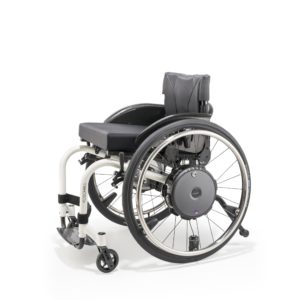
A PAPAW is a manual wheelchair with motorized rear wheels. The wheels are powered by a battery, which is attached to the back of the wheelchair. This type of wheelchair is controlled by normal pushing movements using the pushrims. PAPAWs assist individuals with limited strength or arm function by amplifying the force applied to the wheels. Each push on the pushrim by the user is sensed and proportionally amplified to increase the force to continue the forward movement. This also occurs for braking and turning (e.g., the wheels would detect a backwards force and apply a stronger braking force). This allows for users to go further with a given push, or to brake more efficiently with less force. When desired, the power assist function can be turned off. One limitation of using PAPAWs is the significantly increased weight of the wheelchair, which is especially noticeable when turned off. Another limitation is that the pushrims are damaged more easily, as this is where the sensors are located. Some examples of PAPAWs include the Alber E-motion and the Quickie Xtender.
Front mounted systems
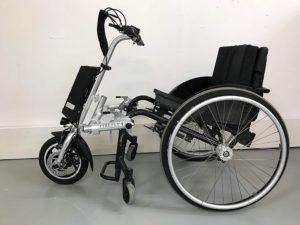
These systems attach to the front of the wheelchair frame and typically lift up the front casters. Non–powered versions exist which are propelled via cranks and chains similar to handcycles. Most often powered, these devices are able to turn manual wheelchairs into a three-wheeled “scooter”. Front mounted systems are usually controlled with a throttle controller, which removes the need to manually propel the wheelchair. They are also able to reach significantly higher speeds in comparison to other power add-ons. A disadvantage to front mounted systems is that they add length to the wheelchair, which may impact the ability to move around indoors. In addition, the devices can be fairly heavy (e.g., the typical Batec system is 25 kg), and little to no customizations can be made. Examples of front mounted systems include the Rio Mobility Firefly, Triride, Klaxon, and Batec.
Rear mounted systems
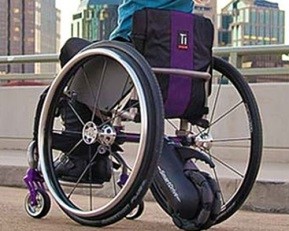
Rear mounted propulsion device generally connect to the bar underneath the wheelchair seat (i.e., the camber tube). These devices can power the wheelchair so that no manual propulsion is required, although turning and braking still require constant user control. Currently, there are two models commercially available that are light, compact, and easily attached: the SmartDrive and the Smoov. The SmartDrive is controlled with a wristband worn by the user. A double tap of the wristband (or similar accelerometer-sensed motion of the hand/arm when tapping the wheel or other surface) will activate the motor and begin accelerating the wheelchair. Another tap sets the speed, while the next double tap will stop the motor. Gripping on the handrim is usually still needed to slow down and stop the chair. Users are not required to propel the wheelchair once it is in motion; they are only required to steer. Good reaction time is required to operate the device; a learning curve is involved when first using the device. The Smoov operates via a frame mounted control knob to set the desired speed. Starting and stopping the motor is accomplished through tapping the knob. Turning, slowing, and stopping are similar to the SmartDrive operation.
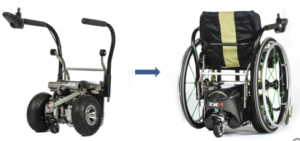
Other rear-mounted systems, such as the Spinergy ZX-1, convert manual wheelchairs into a power wheelchair. The user backs up into the device, which connects to the wheelchair with a push of the button. This add-on lifts up the rear wheels of the wheelchair, converting it into a power wheelchair that is controlled with a joystick.
