
What are health concerns related to manual wheelchair use?
Author: Sharon Jang | Reviewer: Emma M. Smith | Published: 3 March 2020 | Updated: ~
Using a manual wheelchair can be tough on the user’s arms and shoulders. Research has shown that 25-80% of manual wheelchair users experience injuries in their wrists, elbows, and or/shoulders. There have been multiple (weak) studies that have identified multiple factors that can be addressed in order to reduce/prevent the chances of injury:
M uscles required for propulsion
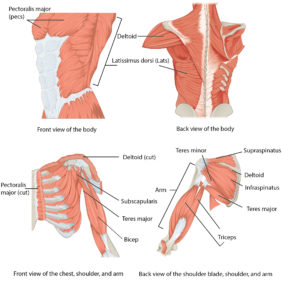
Muscles in the chest, upper back, shoulders, and arms that are used in propelling a wheelchair.17
When pushing a manual wheelchair, many muscles in the upper back, chest, shoulder, and arms are used. Pushing a manual wheelchair is not the most efficient way of getting around, as only between 2-14% of force applied by the arms goes into propelling a wheelchair, depending on the level of injury and style of propelling. The shoulder muscles are particularly strained during wheelchair propulsion as they are relatively smaller muscles that are responsible for both stabilizing the shoulder and applying force to a wheelchair to push it forward . Shoulder pain occurs in 31-73% of manual wheelchair users, and weak evidence suggests that individuals with tetraplegia experience more pain due to greater forces being applied with their arms.
Kinematics: the technique you use when propelling a wheelchair can impact your risk of shoulder pain/injury. For example, pushing a wheelchair at increasing speeds/intensities may contribute to the development of shoulder pain. Additional factors to be considered include the angle of your joints (i.e., the elbows, wrist) when pushing, and the angle at which you push your tires at.
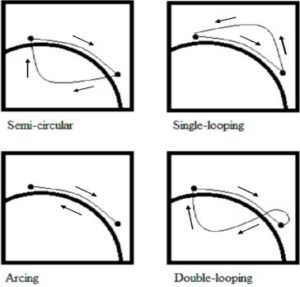
Propulsion pattern: the pattern you push your wheelchair with (e.g., where do your hands go when you push and after you’re done pushing) may also have an influence on your risk of injury. Some weak evidence suggests that using the semi-circular and double-loop-over may reduce the risk of nerve injury and are the most optimal ways to push your wheelchair. Further evidence (weak) has indicated that arcing may be more efficient for short bouts of high intensity pushing (like when going uphill).
Body weight: Weak evidence suggests that having a higher body weight may be related to a higher risk of injury while propelling your wheelchair. This is due to the fact that moving a heavier body requires higher forces created by the shoulders. Body weight management is important in decreasing the amount of force created in your arms when pushing your wheelchair, and reduces the risk of injury.
Wheelchair set up: Having the rear wheels on a manual wheelchair placed in a forward axle position can help improve push rim biomechanics, reduce the amount of force put on your shoulders when propelling, and the frequency of propulsion (i.e., you do not have to push as much to go as far). Research has suggested the use of manual wheelchairs with adjustable axle positions so that the rear wheels can be optimally adjusted.
Wheeling on uneven surfaces: Some research suggests that wheeling across cross slopes (such as a driveway) can increase the forces on the arm and may lead to overuse injuries. In addition, more physiological effort (i.e., heart rate, how much oxygen is being used, rating of perceived exertion) is required to go up slopes more than 2% incline, and more physiological and physical effort is required to go up slopes greater than 8%.
