
What are the benefits of exercise after SCI?
Author: Sharon Jang | Reviewer: Sonja de Groot | Published: 20 April 2022 | Updated: XX October 2024
After SCI, there is deconditioning of muscles, bones, joints, and changes in the heart and blood vessels due to inactivity. This can lead to various secondary complications, such as heart disease, breathing complications, weakening of the bones (osteoporosis), pain, spasticity, and diabetes. Exercise has many positive changes for those with an SCI including muscle type and size, improved muscle strength, independence, well-being, and helping to prevent secondary health complications.
Muscle type, size, and strength

In the body, there are 2 main types of muscle fibers: slow twitch (type I) and fast twitch (type II). Slow twitch muscles are known as the endurance muscles, as they are able to hold a contraction for a long period of time before getting tired. For example, the muscles that are used to keep your head upright are mostly made up of slow twitch muscle fibers. Type II fibers are known for their short burst of speed or strength. They can generate more strength, but get tired really quickly. Over time with an SCI, the muscles with the endurance type (type I) tend to turn into the more fatigable type (type II). There is some moderate-weak evidence that shows that among those with limited movement in their legs, the use of functional electrical stimulation (FES) can help shift muscle fibers from being more fatigable to more endurance based.
After injury, muscles in the body slowly begin to become smaller (atrophy). However, there is moderate to weak evidence that indicates that moving your arms and legs, either passively or actively, can help build muscle up again. Two (weak evidence) studies found that amongst those with limited to no leg function, electrical stimulation (Neuromuscular electrical stimulation (NMES) or FES) can increase the size of the thigh muscles. In addition, there is weak evidence that the use of a body-weight support treadmill can also increase the size of the lower leg muscle, resulting in a partial reversal of muscle shrinking.
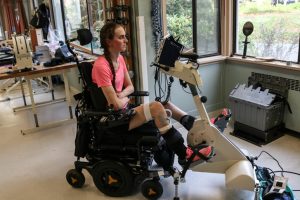
There is strong-moderate evidence that exercising can help individuals of any injury level improve their strength. Among those with paraplegia, there is strong evidence that strength training (i.e., doing weight training) can improve muscle strength in the arms. There is also strong evidence showing that body weight support training can improve overall muscle strength, and moderate evidence that arm cycling can help strengthen the arms and the front of the shoulder. Among those with tetraplegia, there is strong evidence that the use of FES on the arm and shoulder can improve muscle strengthening. Moreover, strong evidence suggests that neuromuscular stimulation (NMES) can improve strength among those with cervical level injuries. If you are unable to access specialized equipment, strength training with free weights or using an arm cycle can show similar benefits as well.
Activities of Daily Living
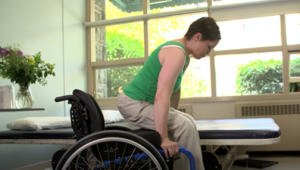
There is some moderate evidence that shows that exercising can enhance the ability to perform daily tasks by yourself. Exercising improves your fitness level (such as your strength and endurance), which can help you perform daily tasks. More specifically, tasks may become easier by reducing physical strain and a decrease in the amount of time required to do an activity. One moderate evidence study found that doing physical therapy exercises in addition to neuromuscular stimulation enhanced participant’s ability to perform self-care (e.g., dressing, feeding, toileting) and mobility (e.g., transferring, wheelchair pushing). Other weak evidence supports these findings, as they found that exercise can help improve transferring and the ability to put on/take off clothing, wheeling and cleaning. Furthermore, increased fitness levels have also been associated with return to work.
Well-being
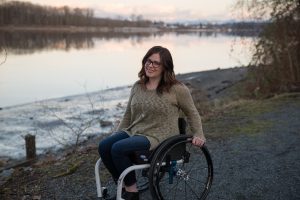
Some evidence suggests that exercise can help individuals improve perceptions of well-being. Well-being has been defined as how well an individual feels in their mind, their satisfaction with their health and functioning, and their overall satisfaction in life. Two aspects of well-being that are relatively well-researched are the impact of physical activity on depression and quality of life. There is weak evidence that found that all types of physical activity can help improve depressive symptoms and can improve quality of life. This relationship between physical activity and depressive symptoms and quality of life can be explained by a strong evidence study, which indicates that exercise can lead to decreased stress and pain. For example, strong evidence has shown that exercise can reduce shoulder pain, which can allow individuals to perform a greater variety of movements without consequences. The reduction in stress and pain, in turn, is thought to improve quality of life and depressive symptoms. However, many of these studies lack a control group. As a result, we are unable to determine if physical activity alone has an influence on subjective well-being.
Secondary complications
After sustaining an SCI, multiple secondary complications can occur. However, research suggests that exercise can help prevent or reduce the severity of secondary complications, including:
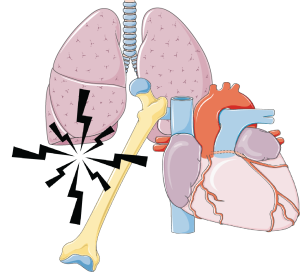
Conditions impacting the heart and blood vessels, by improving the strength of the heart and balancing out the sympathetic (fight or flight; stimulation) and parasympathetic (relax and slowing) nervous systems,
Breathing complications, through strengthening the muscles required for breathing and through increasing the amounts of oxygen taken up by the body,
Weakened bones, by increasing bone mass density,
Type II diabetes, through improving the balance of blood sugar (glucose),
Pain, through strengthening, and
Spasticity, which can be reduced short term with exercising.
