
Will the level of my spinal cord injury affect my ability to breastfeed?
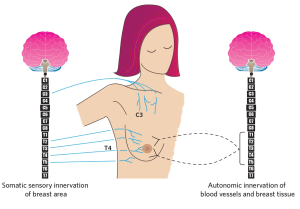
Figure 1. The innervation (control) of the breast by somatic (voluntary) and autonomic (involuntary) nervous systems. The black lines show the autonomic nerves (T1-T5 spinal cord levels) innervating breast tissues and blood vessels. The blue lines show the cervical (C) and thoracic (T) segments of the spinal cord that affect sensory control of the breast and nipple area. Milk production is a result of the coordinated functioning of the somatic and autonomic nervous systems.
The ability to breastfeed could be affected by the level and completeness of your SCI.
First, if your injury is above the first thoracic (T1) spinal cord level the motor functions in your arms/hands could be affected and you could have trouble with positioning and holding your child during breastfeeding. Typically, women with tetraplegia (cervical spinal cord injuries) experience these difficulties (see section on positioning and aids below).
Second, if your injury is above the fifth thoracic (T5 spinal) cord level, this could result in decreased or loss of sensory control of area of the nipple/breast area and affect milk production. These levels of injuries could result also in decrease or loss of body responses that occur during breastfeeding that are important for milk production (physiological reflexes known as “let down reflex”) (See Figure 1)

Watch SCIRE’s video highlighting Sheryl’s experience breastfeeding with a T2-T7 Incomplete SCI.
Recommendation:
Discuss your level of SCI and potential for breastfeeding with medical professionals (such as a physiatrist) and support team before planning a pregnancy or before delivery.
