
Air travel: During the flight
Authors: Sharon Jang , Dominik Zbogar | Reviewers: Duncan Campbell , Janice Eng | Published: 16 November 2022 | Updated: ~
Remember to do pressure relief
During your flight, remember to adjust your sitting position (weight shift) to alleviate pressure from sitting for an extended period of time. To address pressure, some individuals may choose to sit on their wheelchair cushion, which is designed for your seating needs in comparison to generic plane seats. However, participants from an interview study noted that sitting on your wheelchair cushion may add height and boost you up, making it harder to reach in-flight entertainment controls or the call button. In addition, being higher up make make it harder to brace yourself on the arm-rests for balance if you need the support. If you are considering using an air-filled travel cushion, be aware that it can become firmer while you are flying due to air pressure changes and may need to be adjusted.
Deep vein thrombosis
(DVT) is caused by the formation of a blood clot in a deep vein, most often in the legs. Often, clots will dissolve on their own. However, it is possible that a clot can break off and travel to the lungs causing a blockage known as a pulmonary embolism, which can be fatal. The risk of DVT exists (with risk increasing the longer you are sitting still) for those who have underlying risk factors such as decreased mobility. Talk to your doctor about the risk for blood clots before taking your trip and whether you would benefit from preventative treatments such as medications and compression stockings.
Going to the washroom on the plane
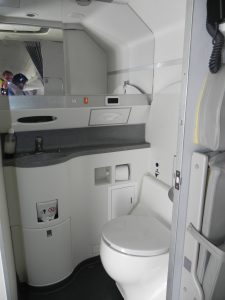
Lavatories on airplanes are small, awkward, and it can be hard to transfer onto the toilet.
Using the washroom (lavatory) on an airplane can be a pain – from transfering out of your seat, to maneuvering in a small washroom space. Some individuals use strategies to prevent the need to use the washroom on the plane. These include:
- Watching your liquid intake the day before, but not witholding fluid for longer flights
- Avoiding caffeine and alcohol 48 hours before a flight and while in flight
- Using the washroom in the airport before you get on the plane
- Using pads to help with unexpected leakage
- Using an overnight catheter bag (which is larger), and draining the bag into a water bottle. Some flight attendants are willing to empty it into the toilet for you.
If you do need to use the washroom on an airplane, be prepared to have to do a tight 180 degree transfer from an aisle chair to the toilet. You may require assistance from a flight attendant to help you get to the washroom, transfer to the toilet, and to return you to your seat.
Autonomic dysreflexia (AD)
The risk of AD is not increased by air travel per se but experiencing it during a flight can be more complicated due to difficulties with moving around the small flight cabin and lavatories. The most common trigger of AD is a full bladder. A full bowel is also a common cause of AD. If you have experienced AD, be familiar with your triggers and take steps to reduce risk before your flight by performing your bowel routine before going to the airport.
Refer to our article on Automatic Dysreflexia for more information!
