
What other complications are related to bladder changes?
Authors: SCIRE Community Team | Reviewer: Bonnie Nybo | Published: 18 January 2018 | Updated: 16 October 2024
Changes to bladder function after SCI can lead to greater risk of developing bladder complications.
Urinary tract infections
A common side effect of bladder problems and their treatments is infections of the bladder and kidneys. These are known as urinary tract infections or UTIs.
Urinary tract infections can be a very serious problem when severe, and if left untreated, they can lead to a life-threatening condition called sepsis. In the early days of SCI care, complications of urinary tract infections were the most common cause of death after SCI.
Today, treatment and prevention of urinary tract infections is much more effective and infections can be treated effectively in most cases. However, it is very important to take steps to prevent infections and to seek out treatment for new infections as soon as they are detected.
The symptoms of urinary tract infections are not always easy to recognize. They usually consist of both generalized symptoms of infection and symptoms related to urination, such as:
- Fever, chills, or tiredness
- Cloudy, red (from blood), or bad-smelling urine
- More frequent or severe muscle spasms
- Autonomic dysreflexia (in people with injuries above T6)
- An urge to urinate often (if sensation is present)
- Pain or burning feeling while urinating (if sensation is present)
- Pain in the abdomen or back (if sensation is present)
If you suspect you might have a urinary tract infection, contact a health provider as soon as possible. Urinary tract infections are usually treated with antibiotics. However, keep in mind that people who use indwelling catheters or intermittent catheterization will often have bacteria in their urine that does not cause symptoms. It is recommended that antibiotics are not taken to treat bacteria unless you also have symptoms.
Kidney and bladder stones
Kidney stones and bladder stones are solid pieces of material that form within the kidneys or bladder. They form because of high concentrations of minerals in the urine and other factors. If these stones become large, it can be difficult to pass them out of the body in the urine, leading to pain and other symptoms. Stones in the kidney can interfere with the filtering of blood and drainage of urine to the bladder. Stones in the bladder can block the flow of urine.
People with SCI are at risk of developing kidney or bladder stones because of changes to how the urinary system works. A number of different factors can contribute to kidney stones, such as improper use of catheters, urinary tract infections, not drinking enough water, backup of urine to the kidneys, and high levels of calcium in the body.
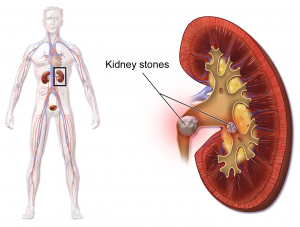
Kidney stones are solid mineral “stones” that form in the kidneys or bladder.2
The symptoms of kidney and bladder stones may include:
- Pain in lower back or abdomen (if sensation is present)
- Frequent urinary tract infections
- Increased sweating
- Blood in the urine
- Increased spasms
- Seeing stones in the urine
- Nausea and vomiting
- Burning or pain during urination (if sensation is present)
Kidney and bladder stones that do not cause symptoms are not treated, but are allowed to pass out of the body on their own. Kidney stones that do cause symptoms are treated with a number of different treatments including medications, extracorporeal shock wave lithotripsy (a form of treatment using ultrasound waves to break a stone into smaller pieces), ureteroscopy (using a thin scope that is inserted into the urethra to break up or dislodge a stone), and surgery. Many bladder stones can be removed at the time of cystoscopy.
Kidney damage and failure
Long-term bladder problems, especially when poorly managed, can damage the kidneys. When kidney damage has progressed to the point where the kidneys no longer function effectively, it is called kidney failure or renal failure.
Bladder problems after SCI can lead to kidney damage if the bladder frequently overfills and cannot empty. Bladder overfilling can result from poor bladder care (such as not emptying the bladder completely or regularly). This can lead to high pressures in the bladder that cause urine to back up to and damage the kidneys.
Kidney failure is permanent and is treated with dialysis or kidney transplants. Early consideration and careful bladder management throughout life is the most important part of preventing kidney damage long-term. This may include catheterizing regularly and on-time, emptying the bladder completely each time, and regularly checking in with your doctor about your bladder care.
Bladder cancer
There is an increased risk of bladder cancer among people who use indwelling catheters. However, screening recommendations are controversial since we do not yet know who needs to be screened, how often, and how soon after injury. Speak to your health provider for more information.
Other related problems
Bladder changes after SCI can also contribute to a number of other medical conditions, such as:
- Bladder complications can cause increased spasticity
- Bladder complications can trigger episodes of autonomic dysreflexia (with injuries above T6)
- Wetness from bladder complications can contribute to skin irritation and breakdown
To learn more about these topics, check out our articles on: Pressure Injuries, Spasticity, and Autonomic Dysreflexia
